


Egat Plans Battery Storage and Solar Expansion for Grid Stability in Thailand
Egat plans large-scale battery storage, 10,000MW of floating solar and about 9,100MW of new combined-cycle gas capacity to stabilise Thailand’s grid under the 2026–2050 PDP.

Egat plans to roll out large-scale battery storage, 10,000MW of floating solar and around 9,100MW of new combined-cycle gas capacity to keep Thailand’s grid stable as renewables expand under the 2026–2050 power development plan.
Quick Skim
Renewables Share Set to Exceed 65% by 2050
The Electricity Generating Authority of Thailand (Egat) has positioned itself as a key pillar of grid stability and power reliability under the new power development plan (PDP), which covers 2026 to 2050.
The plan aims to lift renewable energy’s share of Thailand’s power mix from around 20% to 50% within its first decade, and to more than 65% by 2050 in support of the country’s net-zero emissions target.
“The first 10 years of the PDP will be a critical period for the energy sector,” said Jakree Sirimaneewattana, assistant governor for corporate strategy at Egat. He said the authority will focus on strengthening transmission infrastructure and maintaining grid stability as renewable capacity grows rapidly.
Battery Storage to Manage Solar Intermittency
Mr Jakree said the rapid expansion of distributed solar generation could cause voltage fluctuations and localised blackouts because of solar’s intermittent output. Egat is pushing for faster deployment of battery energy storage systems alongside upgrades to the national grid.
The authority is also preparing for the “duck curve” effect, where solar generation drops sharply in the evening as demand rises. Large-scale batteries will store surplus daytime solar power and release it during night-time peaks. “Egat aims to secure substantial battery storage capacity under the PDP framework to ensure grid resilience and uninterrupted power supply,” he said.
The government has earmarked up to 200 billion baht to support solar development, including rooftop and floating solar, although only around 50 billion baht has been spent so far, according to Finance Minister Ekniti Nitithanprapas. One programme aims to encourage 1 million households to install rooftop solar and sell excess power to the grid.
Floating Solar and Combined-Cycle Gas Plants
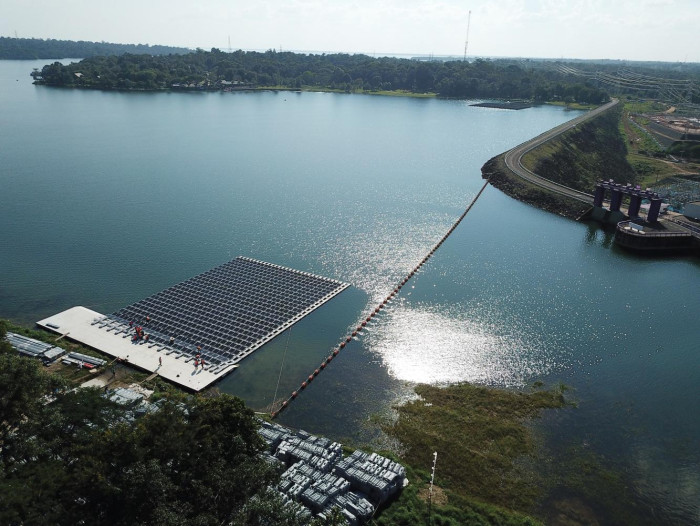
Egat plans to develop 10,000MW of floating solar capacity nationwide, with roughly 2,500–2,600MW expected during the first decade of the PDP. Projects are planned at major reservoirs, including Srinagarind Dam in Kanchanaburi.
The utility is also proposing new combined-cycle gas turbine (CCGT) plants to replace capacity from expiring power purchase agreements with private operators. Around 9,100MW of new CCGT capacity is planned to replace retired units and serve areas with strong demand growth, including Bangkok and the Eastern Economic Corridor.
Mr Jakree said the replacement projects are intended to improve power distribution efficiency and support industrial expansion without increasing Thailand’s overall natural gas consumption.
Photo: Bangkok Post