


Samsung Heavy and Tesser Atomics Develop World’s First Nuclear-Powered LNG Carrier
Samsung Heavy Industries and Tesser Atomics will jointly build a nuclear-powered LNG carrier using Tesser’s Triton reactor for transatlantic trade.

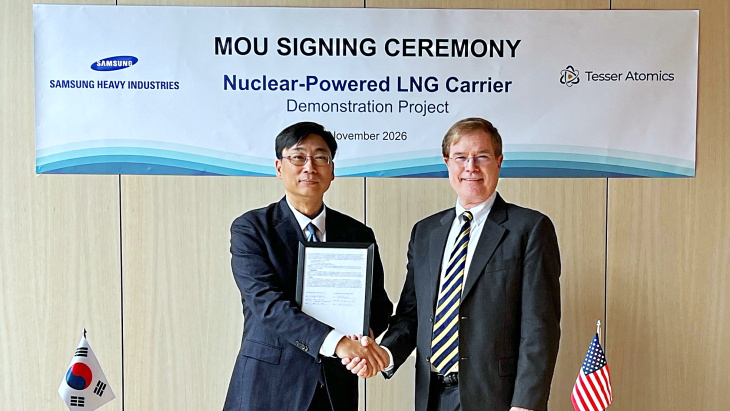
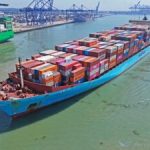
South Korea’s Samsung Heavy Industries (SHI) and US-based Tesser Atomics have agreed to jointly develop the world’s first nuclear-powered liquefied natural gas (LNG) carrier under a Memorandum of Understanding (MoU) signed in Norway on 19 November.
Quick Skim
Exclusive Collaboration for Demonstration Vessel
Under the agreement, SHI will act as the sole shipbuilder for the carrier, responsible for the design and construction of the vessel. Tesser Atomics will provide the nuclear reactor technology, as well as lead the regulatory licensing for the project.
The demonstration vessel is planned to operate on a commercial transatlantic route between the United States and Europe.
Triton Fluoride-Salt Reactor to Power Carrier
Tesser Atomics will equip the LNG carrier with its Triton compact reactor unit, a fluoride-salt-cooled high-temperature reactor (FHR) designed for marine applications. The reactor uses tri-structural isotropic (TRISO) fuel pellets and a low-pressure molten salt coolant.
The reactor allows online refuelling, meaning it can be replenished without shutting down. According to Tesser Atomics, the module is small enough to fit onboard while providing enough power to propel the ship.
Industry Perspectives on Nuclear Propulsion
Dr Per F. Peterson, co-founder and CEO of Tesser Atomics, noted the importance of reliable nuclear fuel and suitable reactor technology tailored for large vessels. He highlighted that the TRISO fuel development was supported by the US Department of Energy over more than twenty years.
“Refuelling while running gives shipowners the option to schedule fuel purchases based on operational needs,” he said. The head of SHI’s Future Business Division said that demonstrating nuclear propulsion on a transatlantic LNG carrier could open new possibilities for decarbonisation in shipping.
Research Foundations and Prior Developments
The initiative builds on research from NuProShip, a Norwegian programme exploring nuclear propulsion options for merchant vessels. Subsequent development has advanced through SFI SAINT, a consortium led by the Norwegian University of Science and Technology’s Ocean Operations and Civil Engineering Department, where Tesser is a member.
Prior to this project, SHI had engaged in designs for nuclear-powered LNG carriers. In September 2025, the American Bureau of Shipping (ABS) and the Liberian Registry granted an Approval in Principle (AiP) to SHI for a 174,000-cubic-metre LNG tanker featuring a molten salt small modular reactor concept developed with the Korea Atomic Energy Research Institute (KAERI).
SHI also partnered with US engineering firm Sargent & Lundy in July 2026 to design a standard floating small modular reactor (FSMR) platform.
Photo: Tesser Atomics, via World Nuclear News