





Japan’s AI Advantage May Be on the Factory Floor, Not in Bigger Data Centres
Japan’s industrial competitiveness could depend less on building ever-larger AI data centres and more on deploying artificial intelligence directly across factories, where manufacturers are already...

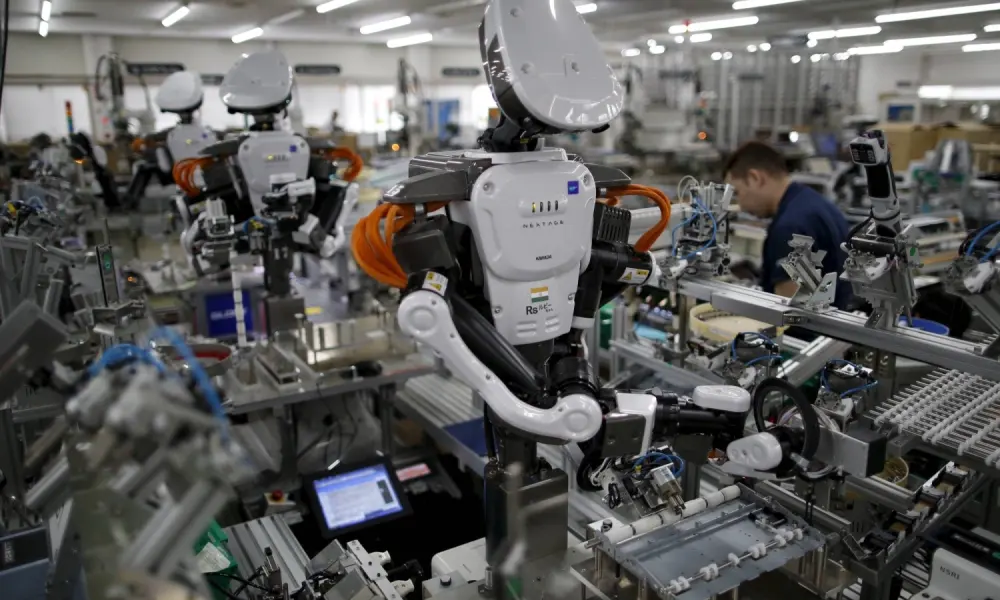
Japan’s industrial competitiveness could depend less on building ever-larger AI data centres and more on deploying artificial intelligence directly across factories, where manufacturers are already using edge AI for quality inspection, predictive maintenance and production optimisation.
Quick Skim
- Toyota Uses AI to Predict Casting Defects
- FANUC Applies AI to Predict Equipment Failure
- AI Automates Quality Inspection at Musashi Seimitsu
- Edge AI Reduces Need for Centralised Computing
- Factory Data Becomes a Strategic Asset
- Japan Builds National Physical AI Infrastructure
- Industrial AI Adoption Becomes the Bigger Test
A commentary published by The Japan Times argues that Japan’s existing strengths in manufacturing, robotics and production engineering provide a practical route for AI adoption, particularly when systems can operate close to machinery without requiring large amounts of centralised computing capacity.
Toyota Uses AI to Predict Casting Defects
AI is already being applied to complex production processes where large numbers of operating variables can influence product quality.
Toyota Industries and Siemens developed an industrial edge system for die-casting operations that collects around 40,000 data points from each casting shot. AI analyses factors such as molten aluminium temperature and injection conditions to identify abnormalities and predict quality problems immediately after casting.
Processing the data at the industrial edge allows decisions to be made close to the production equipment instead of transmitting all information to a remote data centre.
The approach is designed to improve product quality while reducing dependence on manual analysis by highly experienced workers.
FANUC Applies AI to Predict Equipment Failure
Maintenance is another area where industrial AI is moving directly onto the factory floor.
FANUC’s AI Servo Monitor continuously collects and analyses motor data from machine tools to detect early signs of abnormalities in servo and spindle drive systems.
The system converts changes in operating behaviour into anomaly scores and can alert maintenance teams when equipment requires inspection.
FANUC says the technology can use data already available from motors, eliminating the need for additional condition-monitoring sensors in some applications.
This allows manufacturers to shift parts of their maintenance strategy from fixed inspections towards data-driven preventive and predictive maintenance.
AI Automates Quality Inspection at Musashi Seimitsu
Japanese automotive supplier Musashi Seimitsu has also deployed AI for visual quality inspection.
Its system combines AI image recognition with automated inspection equipment designed for mass-production lines. Musashi says the technology has been deployed to inspect transmission gears and other components where strict quality standards apply.
At one production line, a robotic arm can pick up a bevel gear, rotate it against a light source and inspect the component for surface defects in around two seconds.
Musashi has since expanded the technology to inspect larger and more complex components, including aluminium cases used in automotive manufacturing.
Edge AI Reduces Need for Centralised Computing
These factory applications highlight a different model for industrial AI deployment.
Large foundation models require extensive computing infrastructure, but many manufacturing applications involve narrower tasks such as:
- Detecting defective products
- Identifying equipment anomalies
- Analysing production conditions
- Optimising machine performance
- Guiding robots and automated equipment
For these workloads, processing can often take place close to the production equipment using industrial PCs, edge servers or embedded GPU systems.
The Japan Times commentary argues that this could be particularly important for Japan, where the ability to apply AI throughout existing factories may matter more to industrial competitiveness than simply measuring national AI progress by the amount of computing capacity installed.
Factory Data Becomes a Strategic Asset
Japan’s manufacturing base also produces large amounts of operational data that can be used to improve industrial AI systems.
Machine conditions, quality measurements, process parameters, inspection results and maintenance histories can all provide training and inference data for factory-specific AI applications.
Toyota has previously highlighted the use of sensors, IoT and automated inspection as part of its efforts to improve manufacturing, with the goal of using production data not only to identify defects but eventually to prevent them from occurring.
This gives established manufacturers an advantage that cannot be created through computing infrastructure alone: access to real production environments and the engineering knowledge required to interpret factory data.
Japan Builds National Physical AI Infrastructure
Japan is simultaneously investing heavily in larger AI infrastructure.
Nvidia and Noetra are developing a national-scale AI factory that will support Japan’s FRONTia Project, focused on multimodal foundation models for robotics and physical AI.
The planned system will include 27,500 Nvidia Rubin GPUs, 13,750 Vera CPUs and 140MW of data-centre capacity, providing computing infrastructure for applications spanning manufacturing, logistics and robotics.
The opportunity for Japanese industry will be connecting that large-scale model development with practical applications running inside factories.
Industrial AI Adoption Becomes the Bigger Test
Japan already has a deep manufacturing ecosystem spanning industrial robotics, automotive production, machine tools, sensors, motors, semiconductor equipment and precision engineering.
The next stage will depend on how widely manufacturers can integrate AI into those existing operations.
Toyota Industries’ defect prediction, FANUC’s equipment monitoring and Musashi Seimitsu’s automated inspection show how AI can address specific production problems without requiring every workload to run inside a hyperscale data centre.
For Japan, the competitive opportunity may therefore lie in combining its manufacturing expertise with edge AI, robotics, predictive maintenance and smart production systems, turning existing factory knowledge into deployable industrial intelligence.