

Vietnam Sees Rapid Industrial Robot Sales Growth As Manufacturers Leave China
Vietnam’s industrial robotics market is expanding quickly due to factory relocations from China and rising automation demand across multiple sectors.

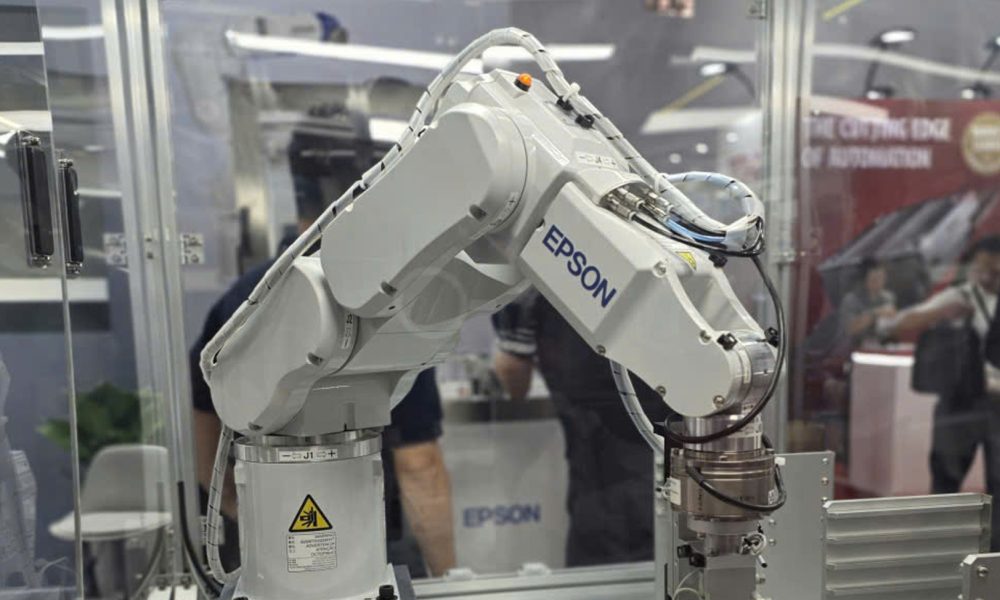
Vietnam has become Southeast Asia’s fastest-growing market for industrial robots, according to Epson, driven by increased manufacturing relocations from China and growing factory automation needs in electronics and other industries.
Quick Skim
- Vietnam’s Robotics Market Expands Amid Factory Relocation
- Epson Features Advanced Robot Technologies at VIAF Bac Ninh 2026
- Industry Adoption Focuses on Electronics, Automotive and Food Processing
- Expanding Robotics Applications Beyond Electronics
- Challenges to Automation Adoption in Vietnam
- Regional Developments Highlight Automation’s Role in Competitive Manufacturing
- Outlook for Industrial Robotics in Vietnam
Vietnam’s Robotics Market Expands Amid Factory Relocation
The global industrial robotics sector is undergoing rapid expansion, with the total number of industrial robots worldwide reaching five million units in 2025, a 9% increase from the previous year, according to the International Federation of Robotics (IFR). This figure has doubled over the past seven years as manufacturers progressively adopt automation technologies.
Epson highlighted Vietnam’s position as the fastest-growing industrial robot market within Southeast Asia, largely benefiting from companies relocating production out of China. This migration is generating significant demand for automated solutions across various manufacturing sectors.
Epson Features Advanced Robot Technologies at VIAF Bac Ninh 2026
At the VIAF Bac Ninh 2026 industrial automation exhibition, Epson demonstrated force-sensing and Gyroplus technologies, which enhance robots’ ability to handle delicate and precise operations seamlessly at high speeds. The company presented improved versions of SCARA and six-axis robots, with payload capacities reaching up to 50 kilograms, designed for easier integration into diverse production environments.
Industry Adoption Focuses on Electronics, Automotive and Food Processing
Ken Nyi Lau, Epson’s regional product manager for Southeast Asia, identified relocation-driven electronics manufacturers as a major contributor to Epson’s increased robot sales in Vietnam. Many customers also come from automotive, food processing, and packaging industries, all of which require automation to boost productivity, ensure quality control and optimise operating costs.
Lau noted the factory relocation trend is expected to continue, presenting further opportunities for industrial robotics uptake in Vietnam. He stated that product durability, precision, and compactness, alongside technical support and customised solutions, remain central to Epson’s strategy.
Expanding Robotics Applications Beyond Electronics
While electronics remain the largest sector for Epson’s robotic sales in Vietnam, the company is planning expansion into automotive manufacturing, healthcare, pharmaceuticals, and food and beverage production. SCARA robots, suited for repetitive high-precision tasks, are targeted at medical and pharmaceutical sectors, while six-axis robots are positioned for automotive assembly requiring flexibility.
Epson has observed increasing interest in robotics from domestic Vietnamese manufacturers, many of whom seek gradual automation adoption within existing factories containing older equipment. Such incremental integration is seen as less disruptive and financially burdensome compared with full production line replacement.
Challenges to Automation Adoption in Vietnam
Despite growing interest, significant obstacles remain for Vietnamese manufacturers, including limited financial resources, workforce skills gaps and awareness of automation benefits. Lau emphasised the importance of cross-sector cooperation and financial support to build confidence in investing in automated production technologies.
Regional Developments Highlight Automation’s Role in Competitive Manufacturing
Epson cited developments in Thailand and Indonesia, where manufacturers increasingly rely on automation to reduce labour costs and maintain quality consistency. Facilities such as Western Digital’s factories in Thailand exemplify the drive towards highly automated production operations to remain competitive.
For Vietnam, the relocation of factories from China provides a dual opportunity to attract manufacturing investment and accelerate the adoption of advanced production technologies. Achieving this potential will depend on the readiness of domestic manufacturers to upgrade capabilities and embrace automation.
Outlook for Industrial Robotics in Vietnam
Epson plans to maintain its existing customer base in Vietnam while expanding into new market segments with advanced automation solutions, particularly focusing on the automotive and healthcare sectors where demand for sophisticated robotics is anticipated to increase. The company continues to prioritise technical support and tailored solutions to meet evolving production needs.
Photo: VietNamNet