





Ship Fuel Shortage Threatens Asia as Singapore Bunker Prices Surge 76%
Asia is facing a tightening supply of marine fuel as refinery disruptions in the Middle East and Russia reduce fuel-oil availability, pushing bunker prices sharply higher and increasing cost pressure...

Asia is facing a tightening supply of marine fuel as refinery disruptions in the Middle East and Russia reduce fuel-oil availability, pushing bunker prices sharply higher and increasing cost pressure on shipping operations.
Quick Skim
- Fuel Oil Deficit Expected in Third Quarter
- Singapore Bunker Fuel Prices Jump 76%
- Middle East Exports Fall 45%
- Russian Refinery Disruptions Add Pressure
- Longer Shipping Routes Increase Fuel Demand
- Higher Fuel Costs Could Feed Into Freight Rates
- Bunker Supply Becomes New Pressure Point for Maritime Operations
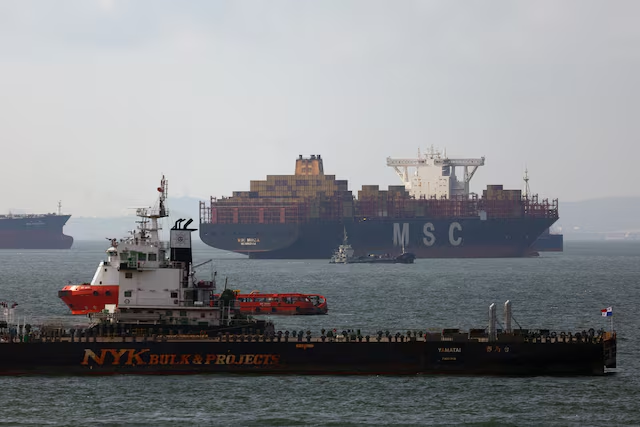
Singapore, the world’s largest bunkering hub, is expected to be particularly exposed because it relies on imports for more than half of its nearly one million barrels per day of fuel-oil demand.
Fuel Oil Deficit Expected in Third Quarter
Energy Aspects expects the global fuel-oil market to face a 218,000-barrel-per-day deficit in the third quarter of 2026, compared with a marginal 6,000 bpd shortfall in the same period last year.
The tightening market comes as refinery outages and disrupted tanker traffic reduce the availability of fuel oil used by ships and some power plants.
At the same time, refiners are prioritising higher-margin products such as diesel, gasoline and jet fuel, further limiting bunker-fuel output.
Singapore Bunker Fuel Prices Jump 76%
The impact is already visible in Singapore.
The price of very low sulphur fuel oil (VLSFO) reached just under US$825 per metric tonne as of September 1, representing a 76% increase since the Iran war began, according to ZeroNorth data.
That increase has significantly outpaced the rise in benchmark crude prices.
Fuel-oil inventories in Singapore, Fujairah and the Amsterdam-Rotterdam-Antwerp hub are also around 30% below their three-year seasonal averages.
Middle East Exports Fall 45%
Supply disruptions across the Middle East are one of the main drivers of the shortage.
Fuel-oil exports from the region fell 45% year on year to an average of 447,000 barrels per day between March and August, according to Kpler data.
Kuwait’s Al-Zour refinery, normally a major exporter of fuel oil, has seen sharply reduced shipments following outages.
Restrictions and security risks affecting major Middle Eastern shipping routes have also complicated the movement of both crude oil and refined products.
Russian Refinery Disruptions Add Pressure
Russia is another source of tightening supply.
Fuel-oil exports from the country dropped to a record-low 591,000 barrels per day in August, compared with an average of more than 860,000 bpd during 2025.
Ukrainian attacks on Russian refinery infrastructure have reduced processing capacity, adding to disruptions already affecting global refined-product markets.
The combination of lower Russian output and weaker Middle Eastern exports has reduced the volume of marine fuel reaching international markets.
Longer Shipping Routes Increase Fuel Demand
Shipping disruptions are affecting demand as well as supply.
Some vessels continue to take longer routes to avoid higher-risk waterways, increasing voyage distances and the amount of bunker fuel required.
Traffic through the Strait of Hormuz has remained below normal levels amid renewed tensions, while disruptions around the Red Sea and Bab el-Mandeb have continued to affect shipping patterns.
Longer voyages increase fuel consumption and operating costs at a time when bunker prices are already elevated.
Higher Fuel Costs Could Feed Into Freight Rates
Marine fuel is one of the largest operating expenses for many commercial vessels.
A sustained increase in bunker prices could therefore raise costs for container shipping, bulk carriers and tankers, with part of the additional expense potentially passed through to cargo owners through higher freight rates.
For manufacturers and commodity traders dependent on maritime transport, this could add another layer of logistics cost across international supply chains.
Asia is particularly exposed because of the region’s dependence on Middle Eastern energy flows and the scale of shipping activity passing through major hubs such as Singapore.
Bunker Supply Becomes New Pressure Point for Maritime Operations
The expected fuel-oil shortage adds another challenge to shipping markets already dealing with disrupted trade routes and higher energy costs.
While crude oil remains available globally, refinery constraints and changing production economics mean sufficient volumes of the specific fuels required by ships cannot be assumed.
For the maritime sector, the immediate focus will be on bunker availability, fuel costs and voyage planning as the third-quarter supply deficit develops.
Singapore’s position as the world’s largest bunkering hub means developments there will be particularly important for shipping operators across Asia.