





Singapore’s TacnIQ.ai Secures US$1.5 Million to Develop AI That Gives Robots a Sense of Touch
Singapore- and California-based Physical AI startup TacnIQ.ai has secured US$1.5 million from In Group Holdings as part of a US$3 million pre-seed funding round. The investment will support the...

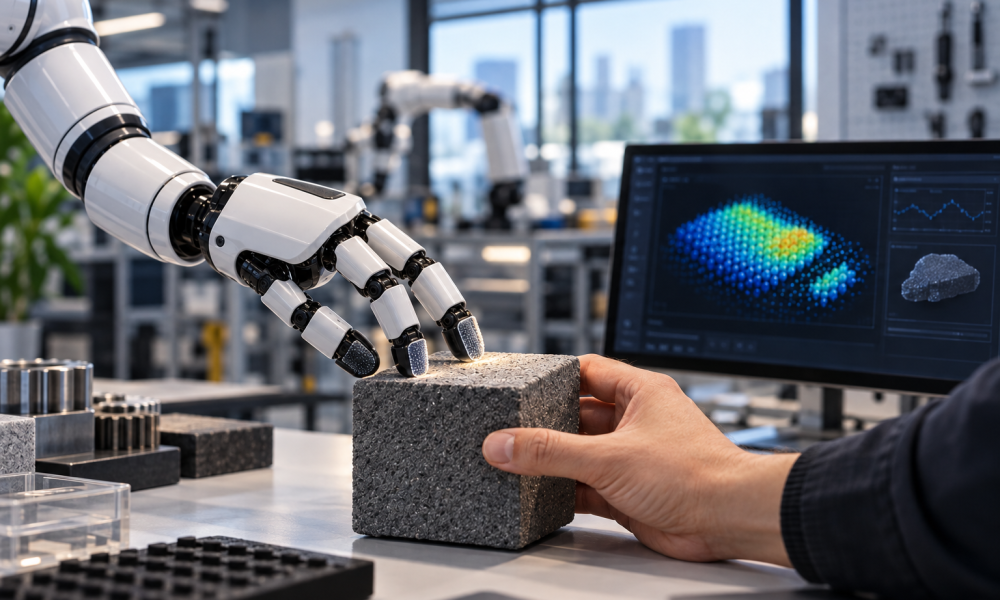
Singapore- and California-based Physical AI startup TacnIQ.ai has secured US$1.5 million from In Group Holdings as part of a US$3 million pre-seed funding round. The investment will support the development of AI models that enable robots and machines to interpret physical contact, alongside an expansion of the company’s engineering team and commercial deployments.
Quick Skim
- Bringing the Sense of Touch to Physical AI
- More Than 5,000 Hours of Tactile Data Collected
- Commercial Deployments Span Five Industries
- Collaboration With Synaptics Targets Commercial Applications
- Funding to Expand Engineering and AI Development
- Tactile Intelligence Opens New Possibilities for Industrial Robotics
Bringing the Sense of Touch to Physical AI
TacnIQ.ai develops tactile AI technology that allows machines to interpret signals generated through physical contact.
While many AI-powered robots rely on cameras and other sensors to understand their surroundings, tactile intelligence helps them recognise and respond to what happens when they physically interact with objects and materials.
The company is developing foundation models designed to process these signals across different tasks and operating environments, with the aim of making physical AI more adaptable to real-world applications.
More Than 5,000 Hours of Tactile Data Collected
TacnIQ.ai said it has accumulated more than 5,000 hours of tactile interaction data from controlled experiments and commercial deployments.
The company describes the collection as one of the world’s largest tactile datasets. It is also developing additional sensor nodes to capture a wider range of physical signals for model training.
Unlike models trained primarily on laboratory data or developed for individual tasks, TacnIQ.ai’s approach draws on interactions recorded across multiple industries and operating conditions.
The company says this could reduce the amount of application-specific training needed when deploying its technology in new environments.
Commercial Deployments Span Five Industries
TacnIQ.ai said its technology is already being used by paying customers in logistics, construction, e-commerce, hospitality and healthcare.
Its wearable data-collection nodes capture information from physical activities, supporting applications related to workplace safety and ergonomics while providing additional real-world data for AI training.
The company’s technology development also extends to robotic manipulation, where tactile feedback can help machines interpret contact while handling materials and objects.
Collaboration With Synaptics Targets Commercial Applications
TacnIQ.ai is also working with semiconductor and interface technology company Synaptics to advance the commercial use of tactile AI.
The collaboration brings together TacnIQ.ai’s physical-interaction models and Synaptics’ expertise in touch and display technologies.
The companies are focusing on enabling machines to process complex physical signals reliably and in real time, a requirement for moving tactile intelligence beyond controlled research environments.
Funding to Expand Engineering and AI Development
TacnIQ.ai plans to use the new investment to recruit engineers, advance its tactile foundation models and expand commercial deployments.
Co-founder and Chief Executive Aashish Mehta said the funding would help the company develop its technology into practical applications that can be deployed at scale.
The company has not disclosed further financial details of the round.
Tactile Intelligence Opens New Possibilities for Industrial Robotics
For industrial automation, interpreting touch is relevant to tasks that involve variable materials, contact forces and object handling.
TacnIQ.ai’s work focuses on developing a common tactile AI model that can be applied across different physical tasks rather than building a separate model for every application.
Its latest funding will support further development of that approach as the company expands deployments and collects more data from real operating environments.