





China’s High-Tech Manufacturing Accelerates as Domestic Demand Remains Weak
China’s industrial production accelerated in August as high-tech manufacturing, industrial robots and battery production posted strong growth, but weaker consumer spending and falling investment...

China’s industrial production accelerated in August as high-tech manufacturing, industrial robots and battery production posted strong growth, but weaker consumer spending and falling investment highlighted an increasingly uneven recovery between the country’s factories and domestic economy.
Quick Skim
Industrial output increased 5.2% year on year in August, up from 4.5% in July and ahead of the 4.8% increase expected in a Reuters poll. Manufacturing output grew faster at 6.1%, according to China’s National Bureau of Statistics.
High-Tech Manufacturing Grows 16.7%
Advanced industries were among the strongest contributors to August factory growth.
China’s high-tech manufacturing output rose 16.7% year on year, while equipment manufacturing increased 12.1%. Both significantly outpaced overall industrial production.
Production growth was particularly strong across technologies linked to automation and electrification:
- Lithium-ion batteries: +57.2%
- Industrial robots: +34.6%
- 3D printing equipment: +29.9%
Computer, communications and electronics manufacturing also increased 17.2%, while specialised equipment manufacturing grew 11.4%.
The figures underline the growing contribution of AI-related technologies, advanced equipment and emerging manufacturing sectors to China’s industrial economy.
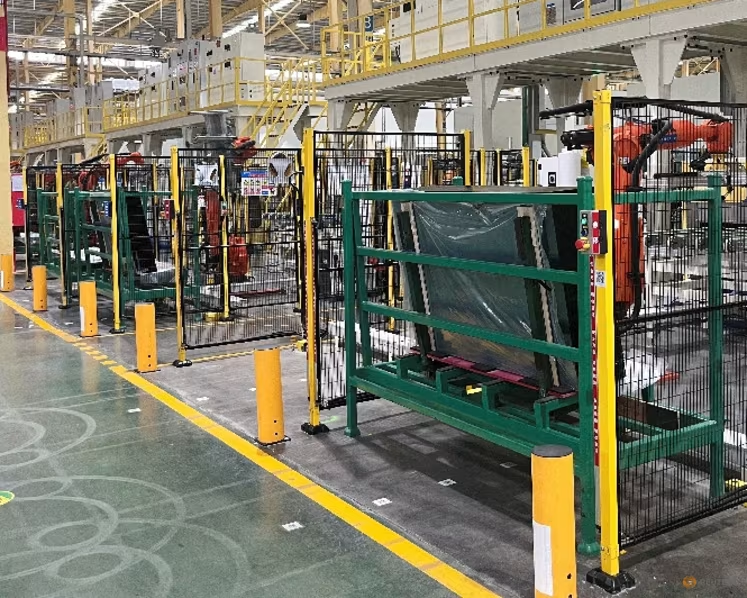
Industrial Robots Reflect Automation Push
Industrial robot production was one of the fastest-growing manufacturing categories during the month.
The 34.6% increase in industrial robot output comes as manufacturers continue investing in factory automation to improve productivity and manage labour and cost pressures.
Other equipment-heavy industries also expanded strongly, including railway, shipbuilding, aerospace and other transport equipment manufacturing, which grew 13.4% year on year.
Electrical machinery and equipment manufacturing increased 9.9%, while general-purpose machinery production rose 9.8%.
Factory Exports Continue to Support Production
External demand is also helping maintain manufacturing activity.
The export delivery value of major industrial companies increased 11.1% year on year in August, according to official data.
Reuters reported that resilient manufacturing and exports continue to support China’s economy even as household spending and domestic investment remain comparatively weak.
That dynamic has allowed technology-focused factories to maintain stronger production growth despite softer conditions elsewhere in the economy.
Consumer Spending Barely Grows
The contrast with consumer activity was significant.
China’s retail sales increased just 0.4% year on year in August, slowing from 0.6% in July and falling short of the 0.8% increase expected by economists surveyed by Reuters.
During the first eight months of 2026, retail sales increased 1.1%, while sales excluding automobiles rose 2.7%.
This means factory production is expanding considerably faster than consumption, reinforcing concerns over whether domestic demand can absorb increasing industrial capacity.
Manufacturing Investment Also Falls
Investment data showed that weakness is not limited to consumers.
China’s fixed-asset investment declined 7.2% during the first eight months of 2026, while manufacturing investment fell 2.3%. Infrastructure investment decreased 4%.
One exception was information-transmission infrastructure, where investment rose 28.4%, reflecting continued spending on digital infrastructure even as broader capital investment contracted.
Reuters also reported a continuing downturn in property investment, adding another drag on domestic economic activity.
Advanced Manufacturing Becomes a Larger Growth Engine
China’s latest data shows an increasingly pronounced split between traditional domestic demand and newer industrial growth engines.
The National Bureau of Statistics estimates that sectors including high-tech manufacturing and digital-product manufacturing contributed more than half of overall industrial output growth during the first eight months of 2026.
For manufacturers and industrial suppliers, the data points to continued expansion in areas such as robotics, electronics, batteries, advanced machinery and digital infrastructure, even as slower consumption and weaker investment create uncertainty around broader demand.
China’s factories are therefore still expanding, but the composition of that growth is becoming increasingly concentrated in technology-intensive and export-oriented manufacturing.