




Korea East-West Power and LOAS Partner on Physical AI Robots for Power Plant Monitoring
Korea East-West Power (EWP) has partnered with industrial AI company LOAS to develop and test physical AI technologies using domestically developed robotic platforms for monitoring power generation...

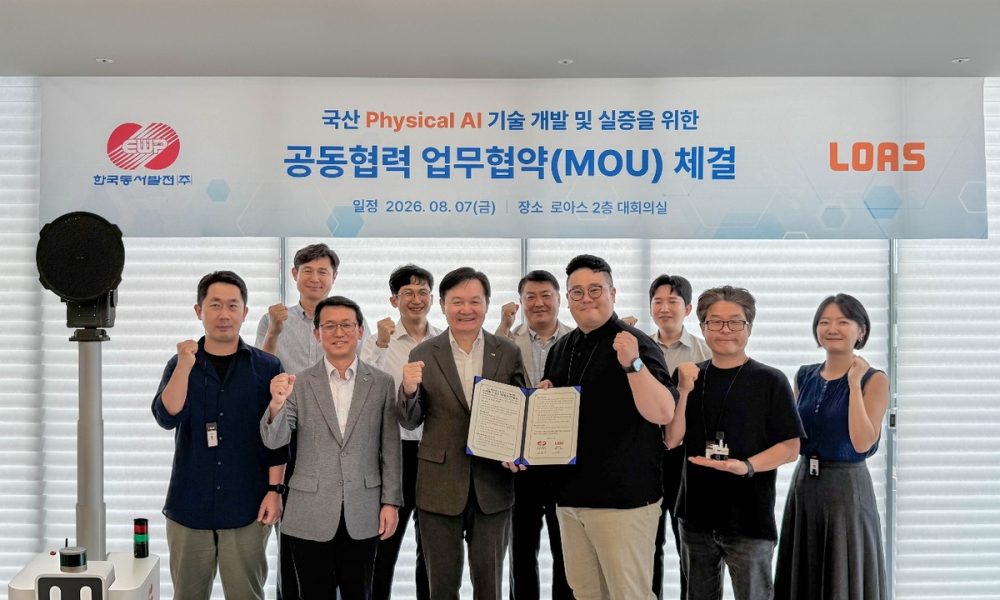
Korea East-West Power (EWP) has partnered with industrial AI company LOAS to develop and test physical AI technologies using domestically developed robotic platforms for monitoring power generation equipment.
Quick Skim
The agreement will explore how AI-powered robots can operate in complex power plant environments, combining equipment control, multi-sensor monitoring and three-dimensional spatial mapping to support the development of smarter power generation facilities.
Robots to Monitor Critical Power Plant Equipment
The demonstration will take place at EWP’s Dangjin Power Generation Complex, focusing on areas where equipment inspection and safety monitoring are particularly important.
One testing environment will be the plant’s pulveriser room, where equipment start-stop cycles and failures have increased as fluctuations in the power grid have grown.
Another will be an indoor coal storage facility, where the risk of spontaneous combustion makes regular equipment inspection and safety diagnosis critical.
AI Robots Combine Sound, Vision and Thermal Sensors
The project will deploy wheeled and rail-mounted AI robots equipped with acoustic, visual and thermal-imaging sensors.
The robots will perform tasks including:
- Detecting abnormal equipment conditions such as vibration and oil leakage
- Inspecting gauges and instrumentation
- Monitoring for fires
- Supporting industrial safety surveillance
The robots are designed to operate continuously for up to six hours.
Data collected during inspections will be securely transmitted in real time through EWP’s internal wireless communications network for use in monitoring power generation equipment.
Real Power Plant Data to Improve Robot Performance
EWP will provide the actual power plant environment needed to evaluate the robots’ operational effectiveness and their potential to improve inspection efficiency.
LOAS will use data collected during the field trials to improve the performance of its industrial inspection robots and further develop the technology.
The robots will also be tested together with ARQOS, LOAS’ domestically developed integrated control platform.
The companies expect the project to contribute to the development of South Korea’s physical AI ecosystem by validating local robotics and control technologies in a real industrial environment.
Technical Standards Planned by End of 2026
EWP plans to complete an effectiveness assessment during the second half of 2026.
The company will then establish technical specifications incorporating essential robot requirements and operational standards based on the results of the demonstration.
The findings will support the development of a physical AI monitoring system that combines robot-based equipment control with 3D spatial mapping technologies suited to power plant environments.
EWP said the initiative goes beyond simply introducing robots into power stations, with the project also intended to establish operational standards through field testing and technical validation.
Physical AI Supports Smart Power Plant Development
The partnership reflects increasing interest in applying physical AI to asset-intensive industrial environments.
By combining autonomous robots with acoustic, visual and thermal sensing, power plant operators can extend equipment monitoring into areas that require regular inspection or present safety risks for workers.
EWP plans to use the project to accelerate its transition towards smarter power generation operations while working with domestic technology companies to advance AI adoption across South Korea’s power industry.