


China Builds Massive Data Centre Hubs as AI Infrastructure Race Accelerates
China is rapidly expanding data centre capacity across energy-rich regions such as Inner Mongolia, using cheap electricity, available land and fast construction to strengthen its position in the...

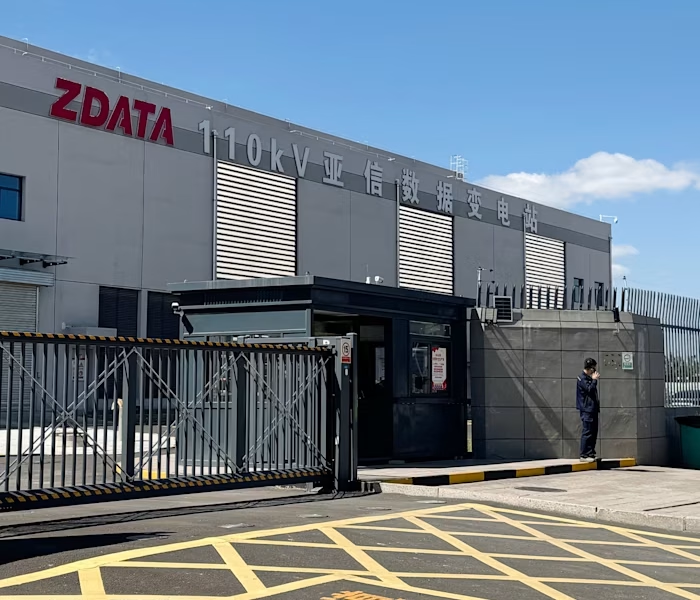
China is rapidly expanding data centre capacity across energy-rich regions such as Inner Mongolia, using cheap electricity, available land and fast construction to strengthen its position in the global AI race even as access to advanced chips remains constrained.
Quick Skim
- Ulanqab Emerges as Major AI Data Centre Hub
- Cheap Power Gives Inner Mongolia an Advantage
- Direct Power Connections Reduce Grid Constraints
- Cold Climate Helps Reduce Cooling Requirements
- China Builds Data Centres Faster and Cheaper
- Advanced Chip Shortage Remains a Major Constraint
- Domestic AI Chips Receive Policy Support
- China Approaches US Data Centre Scale
- AI Race Becomes an Infrastructure Race
The country currently has around 24GW of operational data centre capacity, with another 50GW under construction or announced, creating one of the world’s largest pipelines of AI computing infrastructure.
Ulanqab Emerges as Major AI Data Centre Hub
One of the fastest-growing locations is Ulanqab in Inner Mongolia, where 89 data centres are either operating, under construction or planned.
The city has attracted around 15GW of committed data centre capacity, making it one of Asia’s largest emerging computing hubs.
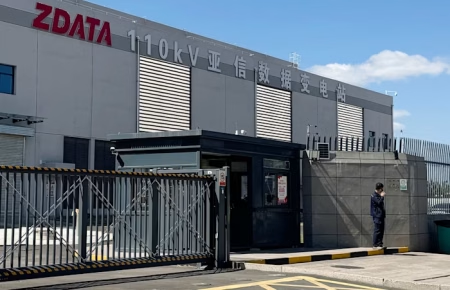
Companies operating or developing infrastructure in the area include Alibaba, Huawei, VNET and ZData, while ByteDance is a major buyer of computing capacity.
AI developers including DeepSeek and Z.ai are also expanding computing infrastructure in the region.
Cheap Power Gives Inner Mongolia an Advantage
Electricity availability is one of the biggest reasons companies are moving into Inner Mongolia.
The region had about 117GW of wind capacity by June, alongside roughly 130GW of mostly coal-fired generation capacity.
This large power supply allows data centres to access electricity at considerably lower prices than in major Chinese cities.
Data centre operators in Inner Mongolia can pay around US$0.05 per kWh, compared with more than US$0.08 in many cities and approximately US$0.11 in Beijing.
For AI data centres running thousands of accelerators continuously, electricity pricing can have a major impact on operating costs.
Direct Power Connections Reduce Grid Constraints
Some facilities are able to connect directly with nearby power plants rather than relying entirely on the national transmission network.
Inner Mongolia’s independent Mengxi electricity grid also gives operators additional flexibility.
This model could become increasingly important as AI data centres require hundreds of megawatts — and potentially gigawatts — of power at individual campuses.
In many other markets, limited grid connections have become one of the main barriers to new data centre development.
Cold Climate Helps Reduce Cooling Requirements
Ulanqab’s colder climate provides another operational advantage.
Large AI clusters generate substantial heat and require significant cooling infrastructure.
Lower outdoor temperatures can reduce cooling energy requirements for part of the year, improving data centre energy efficiency and lowering operating costs.
The combination of cheap land, abundant electricity and natural cooling conditions is helping transform previously less-developed inland regions into large computing hubs.
China Builds Data Centres Faster and Cheaper
Construction speed is another advantage.
Chinese developers are increasingly using standardised and modular construction methods to build large data centre campuses quickly.
Thousands of workers can be deployed simultaneously across individual projects, allowing infrastructure to be completed faster than in markets where developers face longer permitting, labour and grid-connection timelines.
Existing buildings are also being converted into computing facilities. In Ulanqab, one operator is transforming an abandoned school into a data centre.
Advanced Chip Shortage Remains a Major Constraint
China’s biggest limitation is not physical infrastructure but access to high-performance AI processors.
US export restrictions have reduced Chinese companies’ access to the most advanced Nvidia accelerators.
Domestic chipmakers including Huawei, Alibaba, Baidu and Cambricon are increasing production, but demand for AI computing hardware continues to exceed available supply.
This creates an unusual imbalance: China is capable of building data centres and securing electricity at enormous scale, but filling those facilities with sufficient advanced computing hardware remains more difficult.
Domestic AI Chips Receive Policy Support
China is also encouraging data centre developers to use domestically produced processors.
Local governments and other authorities have introduced incentives including lower utility costs and tax benefits for projects deploying Chinese-made AI chips.
The approach is intended to accelerate adoption of domestic hardware while reducing dependence on foreign semiconductor technology.
As Chinese processors improve, the large data centre infrastructure already being built could provide an immediate market for new domestic chips.
China Approaches US Data Centre Scale
China’s approximately 24GW of operational capacity already exceeds the combined capacity of the rest of Asia, although it remains well below the roughly 56GW operating in the United States.
However, the additional 50GW currently planned or under development could significantly narrow that gap.
The build-out also differs from many Asian markets because China can combine large-scale energy development, construction capacity and technology investment within the same industrial strategy.
AI Race Becomes an Infrastructure Race
Competition in artificial intelligence is increasingly moving beyond software models and semiconductor performance.
The ability to secure electricity, land, cooling, chips and construction capacity is becoming equally important as AI models require increasingly large amounts of computing power.
China’s data centre expansion shows how energy infrastructure and industrial construction are becoming central to the global AI competition.
Even with constraints on advanced processors, the country is building the physical infrastructure required to support much larger AI workloads — positioning data centres as a strategic part of its broader technology and industrial development.