


Thailand Prime Minister Meets Five Automakers to Discuss Investment and Local Production
Thailand’s Prime Minister Anutin met top Japanese and Chinese automakers to discuss investment, technology transfer and expanding local automotive production.

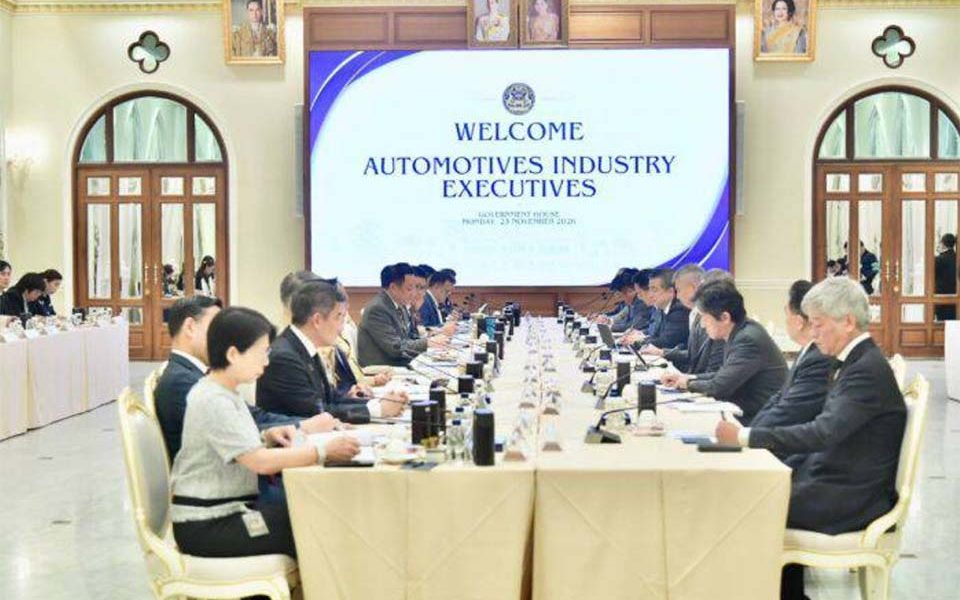
Prime Minister and Minister of Interior Anutin Charnvirakul met representatives of Toyota Motor, Mitsubishi Motors, Isuzu, BYD and Great Wall Motor (Thailand) at Government House in Bangkok on 23 November 2026 to discuss investment, local production and Thailand’s role as a regional automotive manufacturing hub.
Quick Skim
Thailand’s Automotive Workforce and Industry Position
Anutin highlighted Thailand as the largest automotive producer in ASEAN, supported by a skilled workforce of about 750,000 employees. He acknowledged the automotive sector’s importance in driving investment, employment, technological advancement and exports for the country’s economy.
The government is supporting a broad range of automotive technologies, including internal combustion engines and electric vehicles, while committing to ensure fair competition in the sector.
Government Support for Domestic Industry and Investment
The Thai government promotes domestic automotive investment through measures such as the Thailand Fast Pass programme, excise tax incentives and backing for alternative fuels like E20 gasohol and B20 biodiesel. Anutin encouraged the manufacturers to increase local sourcing of parts, transfer advanced technologies and enhance workforce skills to build more resilient and competitive supply chains within Thailand.
Automaker Commitments and Employment Data
Toyota, Mitsubishi and Isuzu reaffirmed their confidence in Thailand’s manufacturing and export capabilities during the meeting. Isuzu also announced intentions to make further investments. BYD reported a workforce of over 6,000 employees in Thailand and exports approximately 40% of its output from the country. Great Wall Motor said it employs nearly 4,000 people locally.
The automakers proposed expansion of fast-charging infrastructure to support electric vehicles, increased support for local production, additional tax incentives and faster trade negotiations.
Balanced Approach to Automotive Transition
The Prime Minister emphasised a balanced transition strategy that supports ongoing conventional vehicle production alongside emerging technologies such as electrification. He reiterated the government’s commitment to working with investors to strengthen Thailand’s competitiveness, expand employment opportunities and reinforce its status as a regional centre for automotive manufacturing, components and logistics.
Photo: Pattaya Mail