






UMC Invests S$6.4 Billion in Singapore Fab as AI Chip Demand Accelerates
Taiwanese chipmaker United Microelectronics Corporation (UMC) is ramping up production at its new US$5 billion (S$6.4 billion) Singapore fabrication plant as demand linked to AI data centres drives...

Taiwanese chipmaker United Microelectronics Corporation (UMC) is ramping up production at its new US$5 billion (S$6.4 billion) Singapore fabrication plant as demand linked to AI data centres drives investment in silicon photonics and advanced semiconductor manufacturing.
Quick Skim
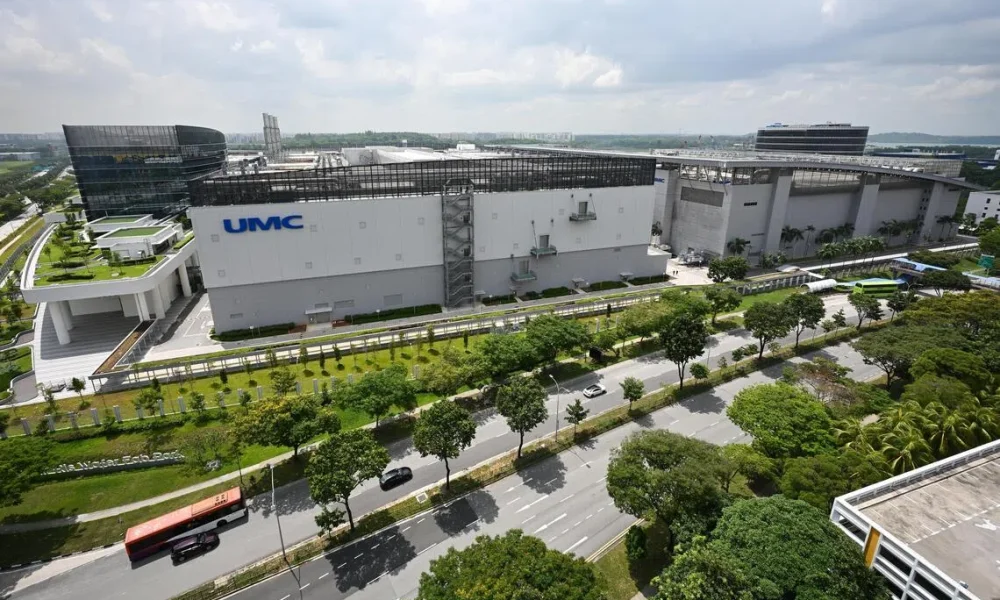
Commercial production at the new facility in Pasir Ris Wafer Fab Park began earlier in 2026. The plant sits beside UMC’s existing Singapore fab and will help raise the company’s annual production capacity in the country to around 1.3 million wafers over the next few years.
The expansion will make Singapore UMC’s largest manufacturing base outside Taiwan.
Singapore Capacity Ramps Up
UMC’s new fab represents a major expansion of its manufacturing footprint in Singapore, where the company has operated for more than two decades.
The facility is designed for 22nm and 28nm semiconductor processes, supporting chips used across communications, IoT, automotive applications and AI-related technologies.
Its first phase has been designed for capacity of up to 30,000 wafers per month, with space available for further expansion.
UMC is also increasing its skilled workforce as production grows, while strengthening research and development capabilities at its Singapore Centre for Advanced Specialty Technologies.
Silicon Photonics Moves Into Mass Production
A key part of UMC’s Singapore strategy is silicon photonics, a technology increasingly used to move large volumes of data between processors and networking equipment inside AI data centres.
In July, UMC and Singapore-based SILITH Technology announced the first mass-production delivery of photonic integrated circuit wafers from UMC’s Singapore 12-inch fab.
The collaboration supports SILITH’s 1.6T silicon photonics platform, which is targeted at high-speed optical interconnects for AI and hyperscale data-centre networks.
Moving silicon photonics into high-volume production gives UMC exposure to a semiconductor segment expected to grow as AI computing clusters demand faster and more energy-efficient data connections.
AI Drives Further Fab Expansion
UMC is already preparing additional capacity to respond to accelerating AI demand.
In July, the company approved a phased expansion that will add cleanroom capacity and new equipment at its Singapore facility, with the investment focused particularly on silicon photonics production.
The building shell for the next expansion phase is already in place, allowing UMC to install additional manufacturing equipment as customer demand increases.
The company said this approach allows it to increase capacity more quickly while keeping capital spending aligned with long-term customer commitments.
Co-Packaged Optics Opens New Growth Area
UMC is also targeting technologies such as co-packaged optics, which integrate optical communications more closely with computing chips.
As AI systems become larger, moving data between processors can consume significant amounts of power and create performance bottlenecks.
Silicon photonics and co-packaged optics are being developed to increase bandwidth while improving energy efficiency across AI data-centre networks. UMC sees its Singapore operations as an important manufacturing and R&D base for these technologies.
Semiconductor Workforce to Expand
The manufacturing expansion will also increase demand for specialised semiconductor skills.
UMC expects to add roles across process engineering, equipment engineering and research and development as production capacity increases. Its earlier expansion plan projected around 700 additional jobs in Singapore over several years.
The company is also strengthening its local R&D team as it develops specialty semiconductor processes linked to AI, connectivity and advanced computing.
This places workforce development alongside manufacturing capacity as an important part of UMC’s longer-term Singapore strategy.
Singapore Strengthens Position in AI Semiconductor Supply Chain
UMC’s investment comes as semiconductor manufacturers and equipment suppliers expand in Singapore to capture demand generated by the global AI investment cycle.
Singapore already accounts for around one in 10 chips and one-fifth of global semiconductor equipment production, making the sector a significant part of the country’s advanced manufacturing base.
Recent investments from semiconductor companies have expanded capacity across wafer fabrication, equipment manufacturing, advanced packaging and other parts of the chip supply chain.
For UMC, Singapore is moving beyond its role as an overseas production site to become a strategic base for silicon photonics, specialty semiconductor manufacturing and AI infrastructure technologies.
With the new fab ramping production and additional cleanroom capacity planned, the company is positioning its Singapore operations for further growth as AI drives demand across the global semiconductor supply chain.