
Maritime and Port Authority of Singapore Opens LNG Floating Storage Unit Licences
MPA invites applications for up to two LNG Floating Storage Unit licences to enhance LNG bunkering capacity and supply resilience.


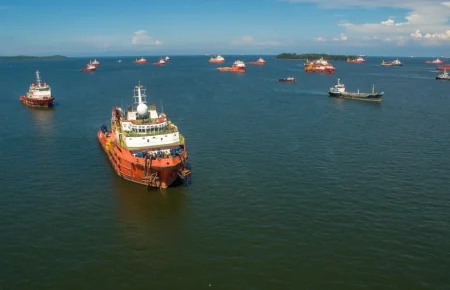
The Maritime and Port Authority of Singapore (MPA) has opened applications for licences to operate up to two liquefied natural gas (LNG) Floating Storage Units (FSUs) in Singapore anchorages, aiming to support LNG bunkering growth and supply resilience.
Licensing Criteria and Operational Requirements
Applications are open to existing LNG bunker licensees, who may collaborate with third-party terminal operators to provide storage and operational expertise. The FSUs must have a minimum storage capacity of 130,000 m³, be registered with the Singapore Registry of Ships, and comply with MPA’s safety and operational standards.
The majority of each FSU’s capacity must be dedicated to LNG bunkering, with a minimum volume accessible to other LNG bunker suppliers on open-access terms. Operators must also disclose maximum fees for LNG reloading services.
Each licence will be valid for five years.
Support for Decarbonisation and Future Fuel Options
To facilitate the decarbonisation of international shipping, the FSUs must be certified under the International Sustainability and Carbon Certification European Union (ISCC-EU) framework. This certification ensures the infrastructure can handle bio-LNG and e-LNG, enabling support for lower-emission LNG alternatives as they become more widely available.
MPA will hold a briefing on 4 December 2026 for interested applicants. Applications must be submitted by 4 February 2027, 5pm to greenport@mpa.gov.sg.
This development complements Singapore’s existing LNG bunker supplier licences awarded earlier in the year and aims to diversify LNG storage and reloading options, strengthening the city-state’s position as a regional bunkering hub.
Stakeholders in manufacturing, shipping, and fuel supply chains should monitor the licensing outcomes and FSU deployments, as they will impact logistics, storage capacity planning, and the availability of LNG and its lower-emission variants in the Asia-Pacific maritime sector.