Zhuzhou Advances China’s Rail Transit Manufacturing with Smart Production
Zhuzhou's rail industry cluster underpins China's export of smart trains, combining integrated supply chains and digital manufacturing.

Zhuzhou, Hunan Province, has developed a rail transit manufacturing cluster exceeding 160 billion yuan ($24 billion), supporting China’s smart manufacturing capabilities and enabling exports of electric multiple units (EMUs) to over 100 countries.
Quick Skim
Complete Local Supply Chain Enables Efficient Production
The city’s industrial base includes CRRC Zhuzhou Locomotive (CRRC ZELC), the world’s largest electric locomotive producer, and CRRC Zhuzhou Institute, which handles key technological development. Over 400 component suppliers operate within a five-kilometre radius, supplying more than 80 percent of parts locally.
This proximity allows design, prototyping, testing, and iteration to occur rapidly. For example, Lince Group supplies cooling systems and fans critical to prototypes, supporting the efficient trial of new products.
Smart Manufacturing Drives Innovation and Quality
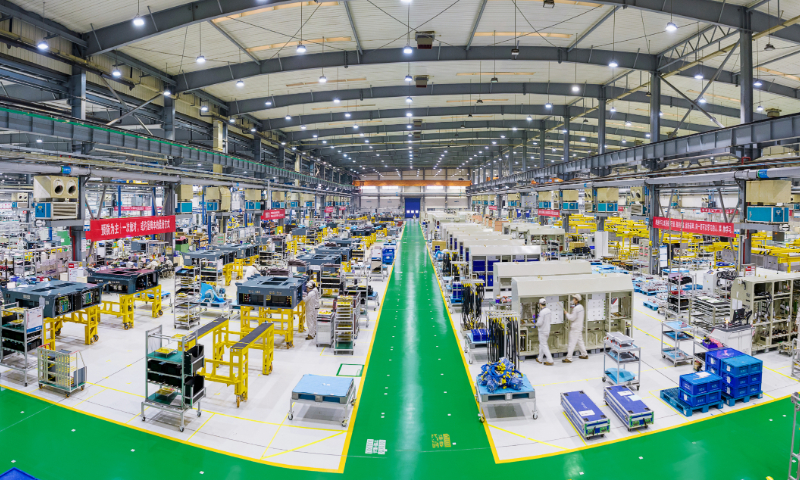
Zhuzhou’s factories employ automation and digital systems, with CRRC Zhuzhou Institute achieving intelligent manufacturing for over 80 percent of its traction drive and control components. The facility operates more than 20 production lines, supplying electrical systems for 200 Fuxing EMUs, 1,000 metro trains, and 840 heavy-haul locomotives annually.
The CRRC ZELC bogie manufacturing workshop is the world’s first intelligent facility dedicated to bogies, using robotics and digital quality control to meet high-precision demands critical to safety and ride quality.
These capabilities support trains like the Fuxing EMU, which operates on the Lhasa-Nyingchi Railway at altitudes over 5,100 metres, incorporating innovations in oxygen supply, lightning protection, and cold resistance, developed through coordinated efforts between complete vehicle manufacturers and local suppliers.
Implications for Asia-Pacific Rail and Manufacturing
Zhuzhou’s integrated model illustrates how clustering and smart manufacturing can optimise industrial operations, accelerating product development and improving supply chain resilience. This supports deployment of advanced rail equipment suitable for diverse environments, from high-altitude plateau routes to metropolitan transit systems as seen in Mexico City.
According to CRRC Zhuzhou representatives, continued investment in digitalisation and innovation is critical to maintaining competitiveness, moving from reliance on foreign technology to independent development of next-generation traction systems such as permanent magnet synchronous motors.
Looking ahead, Zhuzhou is expected to enhance smart production further, contributing to China’s goal of expanding smart factory networks and increasing rail transit exports throughout the Asia-Pacific region.