
HD Hyundai Heavy Industries Increases Welding Robot Use to Enhance Shipyard Productivity
HD Hyundai Heavy Industries aims to raise outdoor welding automation to over 65%, cutting costs through robotic and AI deployment in Ulsan shipyard.

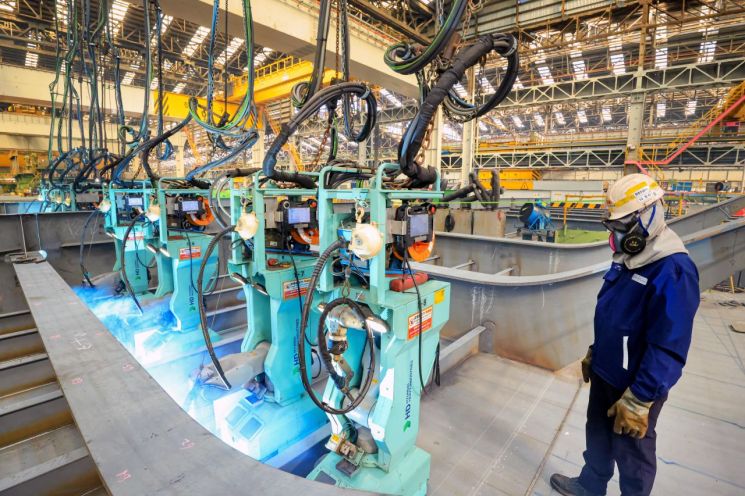
HD Hyundai Heavy Industries has increased the deployment of welding robots at its Ulsan shipyard to boost productivity and reduce costs amid intense competition with Chinese shipbuilders. The company reported that robotics have raised welding output efficiency sixfold at Panel Shop No. 1, signalling a shift towards greater automation across its production processes.
Quick Skim
Robotics Amplify Welding Efficiency and Cost Competitiveness
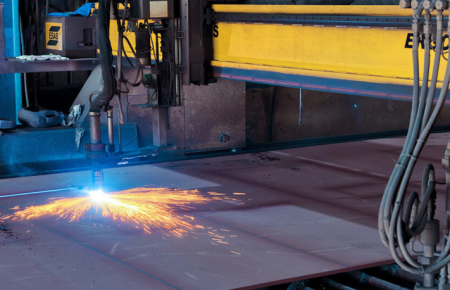
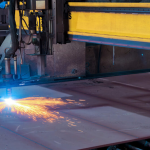
At Panel Shop No. 1, 12 crane-type welding robots are currently operated by just three workers overseeing four robots each, enabling one worker to replace the previous output of six people. Additionally, handheld collaborative robots allow one operator to manage two welding units, increasing productivity per worker by 50% compared to manual operation.
Welding comprises 15-20% of total shipbuilding work, and HD Hyundai Heavy Industries has set a goal to increase welding productivity by more than 30% by 2030, targeting cost reductions exceeding 10%. The company anticipates raising the robot automation rate for external welding from the current 15% to over 65%, closing a price gap of around 10% with Chinese competitors.
Development of Physical AI for Non-Routine Welding Tasks
The current robotic systems operate on pre-programmed data, limiting their application to repetitive tasks. Ships’ complex and varying structures require adaptive capabilities beyond conventional automation.
To address this, HD Hyundai Heavy Industries plans to introduce a physical AI model by the end of 2026 capable of adapting to changing environments and performing non-routine welding tasks. This technology will enable robots to recognise workpiece conditions in real time and adjust operations accordingly. The company aims to start deploying this system on production lines in the first half of 2027.
Executive Director Shin Sangbeom noted that despite China’s advances in AI, mastery over physical AI depends on workers’ expertise and data, which the company views as a competitive strength.
Implications for Industrial Operations in Asia-Pacific
The increased automation and introduction of AI-driven welding are expected to enhance workforce efficiency, reduce labour costs, and improve production cycle times at HD Hyundai Heavy Industries’ shipyard. Enhanced automation will also contribute to greater consistency in quality and safer work environments by reducing human exposure to hazardous welding conditions.
HD Hyundai Heavy Industries’ focus on expanding robotisation and AI capabilities aligns with broader regional trends towards intelligent manufacturing in shipbuilding, supporting sustained competitiveness in Asia-Pacific’s maritime sector.
Looking ahead, the company’s implementation of physical AI represents a significant milestone in automation maturity, with developments over the next two years set to influence operational practices and cost structures within the shipbuilding industry.