





India Pushes to Build Domestic Semiconductor Manufacturing as Supply-Chain Risks Grow
India is accelerating efforts to build a domestic semiconductor manufacturing industry as geopolitical tensions, export controls and dependence on imported chips increase pressure to strengthen local...

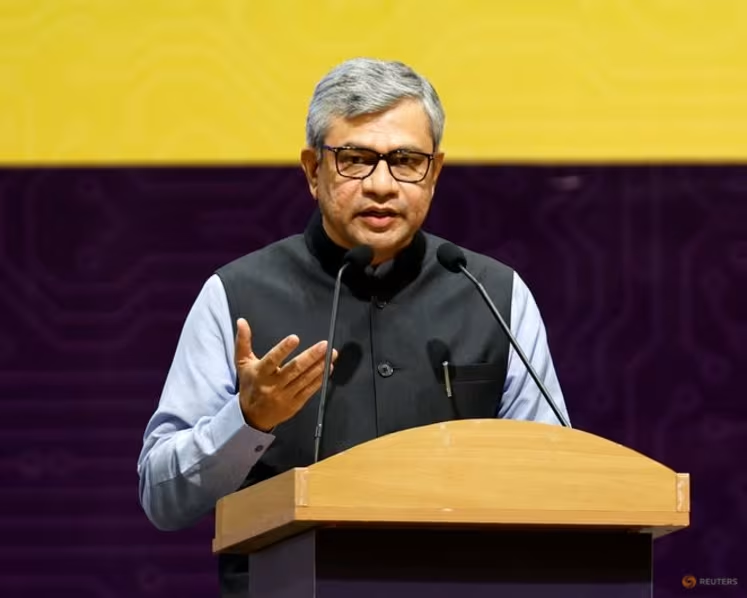
India is accelerating efforts to build a domestic semiconductor manufacturing industry as geopolitical tensions, export controls and dependence on imported chips increase pressure to strengthen local supply chains.
Quick Skim
- Semiconductor Market Expected to Double by 2030
- Tata-PSMC Fab Becomes Key Manufacturing Project
- Assembly and Testing Projects Move Faster
- Previous Fab Projects Highlight Execution Challenge
- High-Volume Manufacturing Becomes the Target
- Supply-Chain Development Remains Critical
- India Has Strong Chip Design Talent
- Building a Full Semiconductor Ecosystem
The country aims to become one of the world’s top four semiconductor manufacturing hubs by 2032, according to India’s Minister for Electronics and Information Technology Ashwini Vaishnaw.
India currently imports around 90% of its semiconductor requirements, leaving electronics manufacturers and other industries heavily exposed to overseas supply.
Between April and November 2025, 48.5% of India’s chip imports came from mainland China and Hong Kong, highlighting the scale of the country’s dependence on external semiconductor production.
Semiconductor Market Expected to Double by 2030
India’s semiconductor market is currently valued at around US$50 billion and is expected to reach approximately US$110 billion by 2030, representing about 10% of global semiconductor demand.
To capture more of this demand domestically, the government has increased support for semiconductor manufacturing through the India Semiconductor Mission (ISM).
More than US$10 billion has been invested through the initiative since 2021, and 10 semiconductor manufacturing projects have been approved over the past four years.
The programme covers different parts of the semiconductor value chain, including wafer fabrication as well as assembly, testing, marking and packaging.
Tata-PSMC Fab Becomes Key Manufacturing Project
A major part of India’s semiconductor strategy is the country’s first commercial wafer fabrication plant, being developed in Gujarat by Tata Group and Taiwan’s Powerchip Semiconductor Manufacturing Corporation (PSMC).
The plant is expected to manufacture chips at process nodes above 28 nanometres, targeting mature semiconductor applications rather than the most advanced AI processors.
Mature chips remain widely used across industrial equipment, automobiles, consumer electronics, telecommunications systems and other electronic products.
Building domestic wafer fabrication capability is considered important because India currently has stronger capabilities in semiconductor design and assembly than in actual chip manufacturing.
Assembly and Testing Projects Move Faster
India has also made progress in semiconductor assembly, testing, marking and packaging, known as ATMP.
Kaynes Semicon began commercial operations at its Gujarat facility and shipped its first chips to a US customer in October 2025. Another eight ATMP projects have been approved under the India Semiconductor Mission.
ATMP facilities generally require significantly less capital and can be developed faster than wafer fabrication plants.
Industry estimates cited by CNA put investment requirements at around US$1.5 billion for an ATMP facility compared with roughly US$10 billion for a major semiconductor fab.
Assembly and testing plants can also become operational within around two years, while a wafer fabrication plant may require up to six years.
This makes packaging and testing a lower-risk entry point as India builds experience across the semiconductor manufacturing process.
Previous Fab Projects Highlight Execution Challenge
India’s semiconductor ambitions have faced several setbacks.
A joint venture between Foxconn and Vedanta collapsed in 2023, while a US$10 billion semiconductor project involving Tower Semiconductor and Adani Group was paused in 2025. Earlier fabrication projects announced in 2014 also failed to materialise.
Several newer projects have experienced schedule changes.
Micron Technology’s semiconductor assembly and testing facility was delayed from late 2024 to February 2026, while Tata’s semiconductor assembly and testing facility in Assam moved from a planned mid-2025 opening to April 2026.
The challenge for India is therefore not only attracting semiconductor investment, but also developing the infrastructure, suppliers, production expertise and manufacturing discipline required to operate fabs successfully at scale.
High-Volume Manufacturing Becomes the Target
India is not initially expected to compete directly with companies such as Nvidia in advanced AI processors.
Instead, industry experts see a larger near-term opportunity in mass-producing lower-cost semiconductor products used across electronics and industrial applications.
InCore Semiconductors co-founder G S Madhusudan said India could potentially capture a significant share of the market for mature, lower-cost chips if it can achieve large-scale production.
The key challenge is maintaining high manufacturing yields while producing chips consistently at volume. Competitive semiconductor manufacturing typically requires yield rates above 90%, meaning the vast majority of chips produced on each wafer must meet quality requirements.
Reliable delivery and after-sales support are also important as India seeks to attract international semiconductor customers.
Supply-Chain Development Remains Critical
Building semiconductor fabs alone will not create a complete domestic ecosystem.
Semiconductor manufacturing depends on specialised equipment, chemicals, gases, materials, components and logistics networks, many of which are concentrated in established manufacturing economies.
Industry experts cited by CNA pointed to China’s integrated semiconductor supply chain as one model India will need to learn from as it develops its own ecosystem.
The need has become more urgent as governments seek to reduce semiconductor supply-chain exposure amid geopolitical tensions.
US export controls on advanced semiconductor technology have highlighted the strategic importance of domestic chip production and created further uncertainty around access to overseas technologies.
India Has Strong Chip Design Talent
While manufacturing remains a developing capability, India already has a substantial semiconductor engineering workforce.
Around one-fifth of the world’s chip designers are based in India, with engineers working for companies including Nvidia, Texas Instruments, Intel and AMD.
However, the country still relies heavily on intellectual property developed by international semiconductor companies.
Industry participants are therefore calling for greater investment in domestic research and development, chip architecture and locally owned semiconductor IP.
Venture capital investment in Indian semiconductor startups rose more than 25-fold over four years to US$569 million in 2025, supporting companies developing chip designs, semiconductor IP and AI hardware.
The government is also preparing a revised Design Linked Incentive programme that could provide funding earlier in the chip development process.
Building a Full Semiconductor Ecosystem
India’s semiconductor strategy reflects a broader push to reduce dependence on imported technology while strengthening the country’s role in global electronics manufacturing.
The country already has a large electronics market, engineering talent and growing semiconductor demand. The next step is building manufacturing capacity capable of delivering chips consistently, competitively and at scale.
If current fabrication, packaging and design investments progress as planned, India could gradually move from being primarily a semiconductor consumer and design centre towards becoming a larger manufacturing base within the global chip supply chain.
The challenge will be turning investment commitments into operating factories while developing the suppliers, intellectual property, manufacturing expertise and infrastructure needed to support the industry over the long term.