






Physical AI Gains Ground in Manufacturing Through Practical, Task-Specific Applications
Physical AI is beginning to find practical applications on the factory floor, but manufacturers are focusing less on sweeping automation and more on targeted technologies that solve specific...


Physical AI is beginning to find practical applications on the factory floor, but manufacturers are focusing less on sweeping automation and more on targeted technologies that solve specific operational problems.
Quick Skim
Rather than factories being transformed immediately by humanoid robots and fully autonomous systems, current adoption is centred on areas including knowledge retention, quality inspection, predictive maintenance and task-specific edge AI.
The approach reflects a broader shift in manufacturing AI towards smaller, specialised systems that can deliver measurable improvements within existing production environments.
Knowledge Retention Emerges as an AI Use Case
One of the immediate applications highlighted for physical AI is capturing the experience of skilled manufacturing workers.
Around one-third of the manufacturing workforce is over 55, according to Smart Industry, creating concerns about the loss of practical knowledge as experienced employees retire.
Manufacturers are beginning to use AI tools alongside experienced operators to document how they troubleshoot equipment and production issues.
This information can then be converted into searchable guidance that helps less-experienced workers understand processes and respond to problems.
Some manufacturers are also experimenting with systems where experienced employees demonstrate tasks directly to machines, allowing operational knowledge to be captured without relying entirely on written procedures.
AI-enabled computer-aided manufacturing tools are also allowing machinists to describe problems using natural language and receive suggested solutions while retaining that knowledge for future use.
Manufacturers Turn to Smaller, Specialised AI Models
Factories are also increasingly using AI models designed for individual manufacturing tasks rather than relying solely on large general-purpose systems.
A specialised vision model, for example, can be trained specifically to identify scratches or defects on one component and operate directly on an edge device close to the production line.
This can provide faster processing and greater accuracy for narrowly defined industrial applications.
Samsung Electronics is taking this approach further as it works towards transitioning its global manufacturing operations into AI-driven factories by 2030.
The company plans to introduce specialised AI agents across areas including production, quality management and logistics, supported by digital twins and manufacturing data.
The developments reflect growing interest in AI systems that are specifically designed around factory processes rather than broad consumer or enterprise applications.
Predictive Maintenance Requires Continuous Model Management
Predictive maintenance remains one of the major manufacturing applications for AI, but industrial models require ongoing maintenance themselves.
Changes in production schedules, raw materials, replacement components and operating conditions can alter equipment behaviour over time. This can reduce the accuracy of models trained on historical data if they are not regularly updated.
Manufacturers therefore need to continually monitor and retrain predictive models as plant conditions change.
The potential operational benefits remain significant when these systems are maintained effectively.
Renault Group reported €270 million in savings in 2023 from its industrial metaverse programme, with predictive maintenance among the areas contributing to those savings. The automaker has connected thousands of pieces of industrial equipment and uses AI across maintenance, logistics and energy optimisation.
NIST data also shows predictive and preventive maintenance among the most common industrial AI applications, with 54% of surveyed manufacturers using AI in this area.
AI Adoption Continues Across Factory Operations
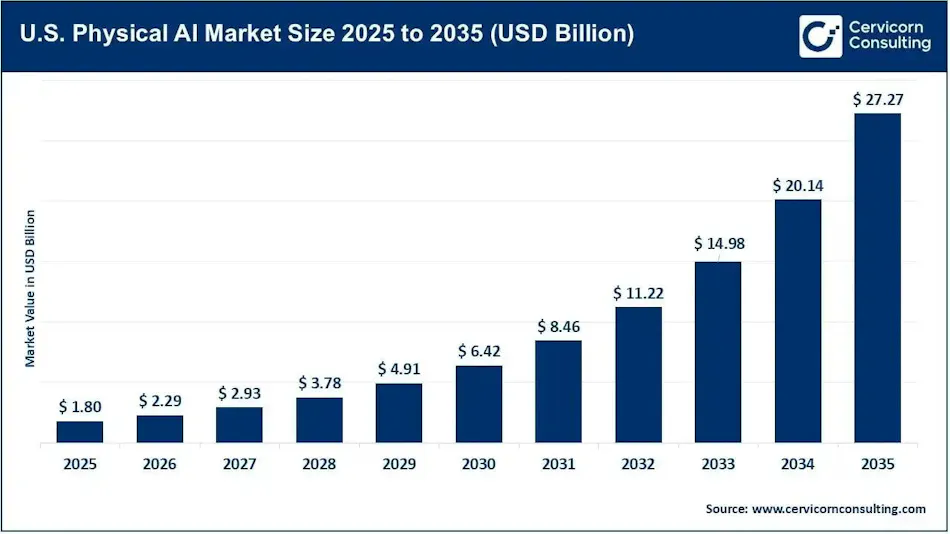
Manufacturing AI adoption is expanding across multiple operational functions.
According to NIST, 46% of US manufacturers are already using AI tools, while more than 80% expect to increase their use of the technology over the next two years.
Applications include process improvement, predictive maintenance, productivity improvement, quality management, production planning, IoT analytics and robotics.
However, broader industrial deployment continues to face challenges around data management, integration with existing equipment and ensuring AI systems can operate reliably within production environments.
NIST’s 2026 smart manufacturing roadmap identifies industrial data complexity, heterogeneous sensing and control systems, and the need for trustworthy and reliable AI as important barriers to wider implementation.
Physical AI Develops Through Focused Factory Applications
The development of physical AI in manufacturing is therefore taking place incrementally.
Instead of immediately replacing existing production systems with autonomous machines, manufacturers are introducing AI where it can address clearly defined operational needs.
Knowledge capture can help preserve experienced workers’ expertise. Specialised vision models can improve defect detection. Predictive maintenance can support equipment reliability, while AI-enabled production systems can improve planning and operational visibility.
Humanoid robots remain part of the longer-term physical AI opportunity, but current factory investment is increasingly focused on technologies that can be integrated into existing industrial processes and demonstrate practical value today.