





Japan Radio Develops Autonomous Navigation System With Human-Like Collision Avoidance
Japan Radio Co. (JRC) has advanced its autonomous navigation technology under the second stage of Japan’s MEGURI2040 project, developing a system designed to plan collision-avoidance manoeuvres that...

Japan Radio Co. (JRC) has advanced its autonomous navigation technology under the second stage of Japan’s MEGURI2040 project, developing a system designed to plan collision-avoidance manoeuvres that more closely resemble decisions made by experienced ship operators.
Quick Skim
- Path Planner Supports Autonomous Collision Avoidance
- Human Navigation Experience Shapes the System
- Existing Vessel Retrofitted for Autonomous Operations
- Mobile Shore Centre Monitors Multiple Vessels
- Shore Teams Can Prepare Voyage Plans
- Ship-to-Shore Roles Remain an Important Development Area
- JRC Plans Commercial Applications
The company worked on onboard systems, shore-based support and ship-to-shore communications as part of the Nippon Foundation-backed autonomous vessel initiative.
Testing was carried out onboard the existing RoRo vessel Daini Hokuren Maru, where JRC integrated autonomous navigation technology with the ship’s existing navigation equipment.
Path Planner Supports Autonomous Collision Avoidance
At the centre of the onboard system is JRC’s Path Planner, which uses information from radar, the Automatic Identification System and other navigation equipment to evaluate collision risks with nearby vessels.
The system can propose alternative routes and work with electronic chart display systems and autopilot equipment to control the ship’s navigation.
During the second stage of development, JRC focused on improving how the system responds to surrounding traffic.
Rather than simply calculating a route that avoids another vessel, the goal was to generate manoeuvres that appear natural and predictable to crews operating nearby ships.
Human Navigation Experience Shapes the System
Development incorporated feedback from experienced navigators and knowledge provided by officers from Kawasaki Kisen Kaisha.
A simulator operated by the shipping company was used to recreate Daini Hokuren Maru and repeatedly test proposed collision-avoidance routes.
The development team adjusted the system to avoid unnecessary reactions to vessels displaying irregular movements and to prevent excessively large deviations from the planned route.
JRC said the objective was to reproduce the judgement developed by experienced navigators so autonomous manoeuvres would not feel unusual or unpredictable to human crews.
Existing Vessel Retrofitted for Autonomous Operations
Another focus of the project was demonstrating that autonomous navigation technology can be introduced onto an existing commercial vessel.
JRC integrated the new system while continuing to use Daini Hokuren Maru’s existing navigation equipment.
The vessel was then tested on its normal commercial route, providing operational data and feedback from real voyages rather than relying solely on simulations.
The trials allowed developers to identify situations where autonomous technology still requires human judgement or additional operational support.
Mobile Shore Centre Monitors Multiple Vessels
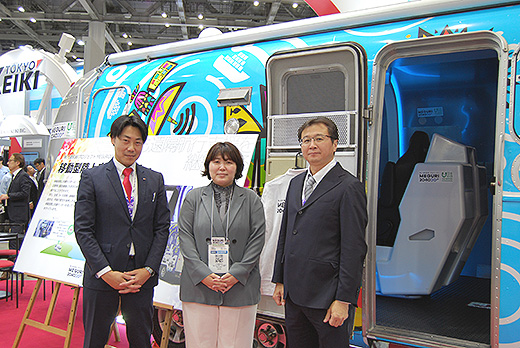
JRC also developed a mobile Fleet Operations Centre (FOC) designed to monitor and support multiple vessels from shore.
The centre can monitor both navigation and machinery information and was designed to continue operating if a permanent shore facility becomes unavailable during an emergency or disaster.
Vessel information is collected through JRC’s J-Marine Cloud platform and displayed through functions based on its Smart Ship Viewer solution.
Shore operators can monitor information including vessel position, track, speed, heading and autonomous navigation status.
The system can also receive information from vessels equipped with systems supplied by other companies through cloud-to-cloud connectivity.
Shore Teams Can Prepare Voyage Plans
The project also developed functionality allowing shore-based teams to prepare voyage plans and transmit them to vessels.
Operators can review weather and other information while creating the route.
Historical AIS information stored in J-Marine Cloud can also be used to estimate expected vessel traffic around the planned arrival time.
The capability is intended to improve coordination between autonomous vessels and shore-based operators as shipping moves towards operating multiple vessels with greater levels of automation.
Ship-to-Shore Roles Remain an Important Development Area
JRC said real-world trials highlighted limitations that are difficult to identify through technology development alone.
Fully autonomous operations will still encounter situations that cannot be handled entirely by onboard systems, making it important to determine when shore-based operators need to intervene.
The company also found that effective shore support requires more than displaying vessel information remotely.
Operators need to understand which information is most important when monitoring multiple vessels and how responsibilities should be divided between the vessel and the shore centre.
JRC Plans Commercial Applications
JRC plans to use the experience from MEGURI2040 to develop future autonomous navigation products and services.
Rather than offering a single standard system, the company intends to provide different combinations of capabilities depending on vessel type, operating model and customer requirements.
The company is also considering further integration of some shore-support functions into Smart Ship Viewer.
By combining navigation equipment with communications, cloud infrastructure and shore-based systems, JRC aims to develop autonomous vessel technologies that can be introduced into both newbuilds and existing ships.