


South Korea Puts Critical Minerals and Energy at Centre of First Central Asia Summit
South Korea is deepening cooperation with Central Asia on critical minerals, energy and industrial supply chains, signing more than 70 agreements and memoranda during its first leaders’ summit with...

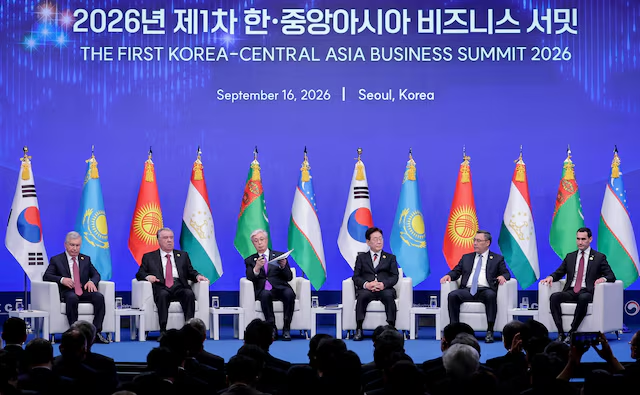
South Korea is deepening cooperation with Central Asia on critical minerals, energy and industrial supply chains, signing more than 70 agreements and memoranda during its first leaders’ summit with the region’s five countries.
Quick Skim
President Lee Jae Myung hosted the leaders of Kazakhstan, Uzbekistan, Turkmenistan, Kyrgyzstan and Tajikistan in Seoul, with discussions spanning mining, nuclear energy, infrastructure, technology and investment. The September 16 summit marked the first multilateral meeting at leaders’ level between South Korea and the five Central Asian states.
Critical Minerals Move to Centre of Supply-Chain Strategy
South Korea is looking to Central Asia as it diversifies access to minerals needed across semiconductors, batteries, electric vehicles and other advanced industries.
Lee said cooperation should extend beyond purchasing raw materials to cover the full critical-minerals value chain, including exploration, development, processing and final-product manufacturing.
South Korea also plans to support rare-metals centres in Central Asia that can facilitate joint research, technology development and workforce training.
The approach could give Korean manufacturers greater access to resource-rich markets while creating opportunities for more processing and industrial activity within Central Asia.
Kazakhstan Partnership Expands Into Nuclear and Oil
Energy cooperation was particularly prominent in talks with Kazakhstan.
South Korea and Kazakhstan signed a memorandum on peaceful nuclear-energy cooperation, alongside agreements covering crude oil, science and technology. The two countries also elevated their relationship to a comprehensive strategic partnership.
Kazakhstan is a major producer of uranium and other mineral resources, making it increasingly important to countries seeking more diversified sources of strategic commodities.
The two governments also discussed expanding critical-minerals trade, including resources such as lithium.
Korean Industry Looks Beyond Raw Materials
South Korean companies are also examining opportunities to participate in infrastructure and industrial development around Central Asia’s resources.
SK Group Chairman Chey Tae-won called for broader cooperation spanning critical minerals, renewable energy and nuclear power during the summit period.
This reflects a wider effort by Seoul to connect Korean engineering, manufacturing and energy technology with resource development rather than treating Central Asia solely as a supplier of commodities.
Potential opportunities extend across mining equipment, processing facilities, electricity infrastructure and downstream manufacturing.
More Than 70 Agreements Signed
Three days of bilateral and multilateral meetings produced more than 70 agreements and memoranda of understanding across energy, mining, infrastructure, technology and investment.
The summit also established a regular leaders’ meeting, with the next South Korea-Central Asia summit scheduled to be hosted by Kazakhstan in 2028.
Seoul said the new format builds on the Korea-Central Asia Cooperation Forum established in 2007, moving engagement from ministerial dialogue towards a more structured leaders-level partnership.
Supply-Chain Diversification Drives Engagement
South Korea’s renewed focus on Central Asia comes as governments and manufacturers seek alternatives to highly concentrated global supply chains for critical materials.
Minerals used in batteries, semiconductors, renewable-energy systems and advanced manufacturing have become increasingly important to industrial competitiveness and economic security.
South Korea’s strategy is therefore combining resource access with processing, technology transfer, energy projects and manufacturing cooperation, creating a broader industrial relationship with Central Asia.
The summit suggests that critical minerals and energy infrastructure will remain central to Seoul’s efforts to diversify the supply chains supporting its semiconductor, battery and advanced-manufacturing industries.