





Everyone Is Selling AI. But What Happens When the Hardware Gives Out?
As AI and software take centre stage in industrial automation, one question remains surprisingly fundamental: what happens when the physical systems underneath them fail? Artificial intelligence is...

As AI and software take centre stage in industrial automation, one question remains surprisingly fundamental: what happens when the physical systems underneath them fail?
Quick Skim
Artificial intelligence is becoming increasingly visible across manufacturing. From predictive analytics and digital twins to machine vision, robotics and autonomous systems, much of the conversation today centres on smarter software.
But factories still run on something much more physical.
Motors turn. Bearings wear. Sensors drift. Cables loosen. Robots move. Drives, controllers and mechanical components operate continuously under real-world conditions.
And when one of those components stops working, even the smartest software has limits.
At Automation SolutionGO! & RINC 2026 in Singapore, Industrial Gemba went onto the exhibition floor to ask vendors and industry professionals a deceptively simple question:
What dies first? hardware or software?
Software Is Getting Smarter. The Physical World Hasn’t Disappeared.
Automation SolutionGO! 2026 brought together manufacturers, technology providers and industry professionals around applied automation, manufacturing transformation and technology adoption. The programme covered areas including robotics, physical AI, digital twins, machine vision, IoT and smart manufacturing.
Those technologies increasingly combine two worlds: physical equipment and digital intelligence.
Software can monitor a machine, recognise patterns and increasingly help operators make decisions. But its information ultimately comes from physical assets — sensors, controllers, motors, cameras and other equipment operating on the factory floor.
That makes the hardware-versus-software question less about choosing a winner and more about understanding their dependency on one another.
When Hardware Fails, Software Can Only Do So Much
Industrial equipment operates in environments very different from a laptop or cloud server.
Heat, vibration, contamination, load variations and continuous operating cycles can gradually affect physical components. Mechanical wear is unavoidable, while electronics and sensing equipment also have finite operating lives.
Software does not experience mechanical wear in the same way, but it brings its own vulnerabilities — configuration problems, communication failures, compatibility issues, cybersecurity risks and outdated systems can all disrupt operations.
The important distinction is that a digital system may still be functioning perfectly while the machine it is monitoring is physically deteriorating.
That is why increasingly intelligent factories still require strong fundamentals in maintenance, condition monitoring and equipment reliability.
AI Makes the Hardware More Important, Not Less
The growth of industrial AI may actually increase the importance of reliable hardware.
Consider an AI system designed to detect equipment anomalies. Its output depends on the information reaching it from physical sensors. Poor sensor placement, damaged equipment, unreliable connectivity or inaccurate measurements can affect everything that happens further up the digital stack.
The same principle applies to machine vision, robotics and autonomous equipment.
AI can help machines become more intelligent, but intelligence cannot compensate indefinitely for a failing physical system.
For manufacturers, the future therefore may not be a contest between hardware and software at all.
It is about building systems where machines, sensors, automation, data and intelligence work reliably together.
So, What Dies First?
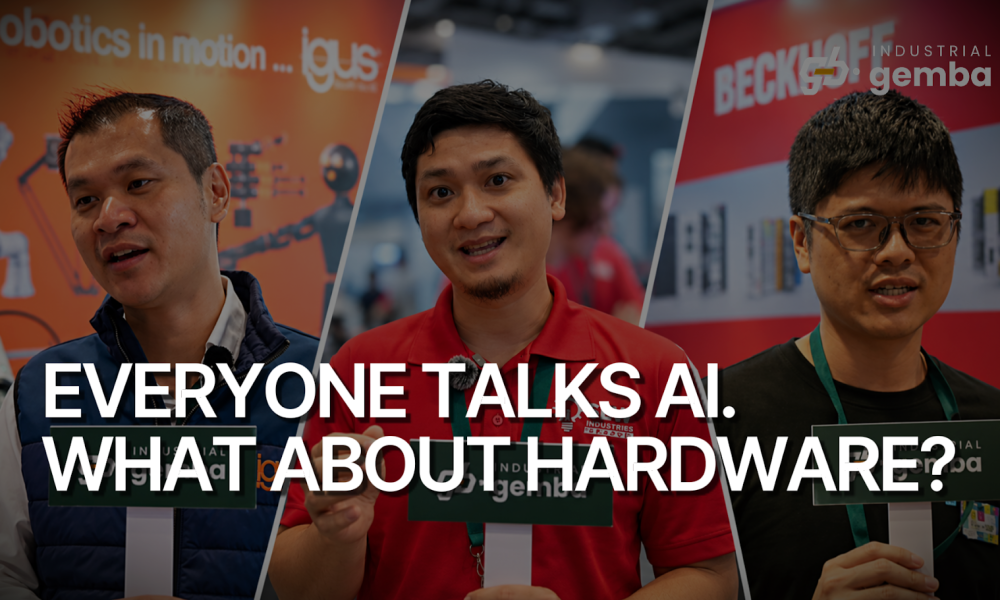
On the Automation SolutionGO! floor, Industrial Gemba put that question directly to people working across automation, robotics, engineering and industrial technology. The conversation included representatives from companies spanning motion systems, automation controls, machine vision, industrial components and AI.
Their answers highlight something easily overlooked amid the AI boom: industrial transformation still happens in the physical world.
The algorithms may become smarter.
The software may become more autonomous.
But somewhere underneath it all, something still has to move the machine.
Watch the full video above and tell us: what do you think will fail first — hardware or software?