






AI Data Centre Boom Drives Demand for Power and Cooling Equipment Across Asia
The global AI data-centre build-out is driving a surge in demand for transformers, power-distribution equipment and advanced cooling systems, creating new growth opportunities for industrial...

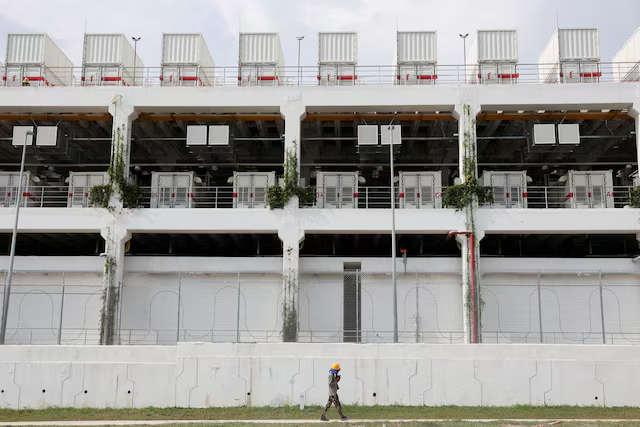
The global AI data-centre build-out is driving a surge in demand for transformers, power-distribution equipment and advanced cooling systems, creating new growth opportunities for industrial suppliers across South Korea, China and Taiwan.
Quick Skim
- Transformers Become Critical Data Centre Equipment
- Power Infrastructure Becomes a Project Bottleneck
- Solid-State Transformers Gain Attention
- Cooling Demand Rises With AI Rack Density
- Taiwan Suppliers Expand AI Infrastructure Business
- Data Centre Build-Out Opens Wider Industrial Supply Chain
- AI Growth Turns Data Centres Into an Infrastructure Challenge
McKinsey estimates that global data-centre investment could approach US$7 trillion by 2030, as hyperscalers and technology companies race to add computing capacity. Power and thermal infrastructure are emerging as critical constraints to how quickly those facilities can be delivered.
Transformers Become Critical Data Centre Equipment
The growth of AI computing is increasing demand for electrical equipment that can deliver large amounts of power reliably to increasingly dense server environments.
Transformers are particularly important because they convert electricity from transmission grids into voltage levels suitable for servers, cooling systems and other data-centre equipment.
South Korea’s HD Hyundai Electric and China’s Hainan Jinpan Smart Technology have reported strong demand linked to new AI infrastructure projects. Reuters reported that HD Hyundai Electric’s order backlog reached US$8.5 billion at the end of June, up 23% from six months earlier.
Some production capacity for major power equipment is already being secured several years in advance, highlighting the pressure on the electrical-equipment supply chain.
Power Infrastructure Becomes a Project Bottleneck
The speed at which AI data centres are being planned is increasingly outpacing the development of the infrastructure needed to power them.
While hyperscale operators may target construction timelines measured in months, securing grid connections and electrical equipment can take considerably longer.
McKinsey estimates that about US$1.3 trillion of the AI-related data-centre investment required through 2030 could flow into power generation and transmission, cooling and electrical infrastructure.
The imbalance is creating opportunities for industrial manufacturers capable of increasing transformer, switchgear, cooling and power-management capacity quickly.
Solid-State Transformers Gain Attention
Equipment suppliers are also developing new technologies to handle the higher power density of AI computing.
One emerging technology is the solid-state transformer, which replaces conventional magnetic components with power semiconductors to manage and distribute electricity.
HD Hyundai Electric, Hainan Jinpan and Taiwan’s Delta Electronics are among companies developing technology in this area as data-centre operators seek more compact and efficient power architectures.
The technology remains at an early stage of commercial adoption, but growing rack densities could accelerate investment in new approaches to electricity distribution.
Cooling Demand Rises With AI Rack Density
Cooling infrastructure is experiencing similar pressure.
More powerful AI processors generate considerably more heat than conventional computing equipment, requiring operators to rethink how heat is removed from servers.
Liquid cooling is consequently gaining ground as an alternative to traditional air cooling for high-density AI environments. Reuters cited Bank of America estimates that liquid cooling could account for 70% of new AI data-centre installations by 2030, compared with around 30% today.
McKinsey also identifies power and thermal equipment as two of the most important infrastructure areas supporting the next phase of data-centre growth.
Taiwan Suppliers Expand AI Infrastructure Business
Taiwanese manufacturers are among the companies benefiting from the shift.
Delta Electronics supplies power-management and thermal solutions for data centres and is expanding its portfolio for increasingly dense AI facilities.
At Computex 2026, the company introduced a prefabricated AI modular data-centre system integrating power, cooling, piping and IT infrastructure, alongside technologies designed for future megawatt-level server racks.
Delta has also been strengthening its operations across Southeast Asia as demand for power-management and data-centre infrastructure increases.
Other Taiwanese thermal-management suppliers are also gaining exposure as demand for liquid cooling expands.
Data Centre Build-Out Opens Wider Industrial Supply Chain
The AI infrastructure boom is increasingly extending beyond semiconductor manufacturers.
Data-centre projects require transformers, switchgear, power-distribution systems, backup generation, cooling systems, pumps, piping and increasingly sophisticated thermal-management equipment.
This is creating a wider industrial supply chain around AI investment, with manufacturers of electrical and mechanical infrastructure becoming increasingly important to project delivery.
At the same time, shortages of components and rising competition could pressure supplier margins even as order books grow.
AI Growth Turns Data Centres Into an Infrastructure Challenge
The next stage of AI expansion will depend not only on access to processors but also on whether enough electricity and cooling capacity can be delivered alongside them.
As facilities move towards higher-density computing, power and thermal infrastructure are becoming central to data-centre design and capacity planning.
For industrial suppliers across Asia, that is turning the AI boom into a broader equipment opportunity spanning transformers, power electronics, liquid cooling and next-generation data-centre infrastructure.