






China Expands Smart Factory Network as AI Becomes Key Manufacturing Benchmark
China has built more than 43,000 basic and advanced smart factories as artificial intelligence becomes an increasingly important benchmark for the country’s highest-level manufacturing facilities....

China has built more than 43,000 basic and advanced smart factories as artificial intelligence becomes an increasingly important benchmark for the country’s highest-level manufacturing facilities.
Quick Skim
China has established a four-tier smart factory development framework designed to guide manufacturers from basic digitalisation towards increasingly connected, automated and intelligent production.
As of June 2026, the programme included around 35,000 Basic-level factories, more than 8,200 Advanced-level factories, over 500 Excellence-level factories and 15 companies selected for the Leading Smart Factory Cultivation Program.
The programme forms part of China’s broader effort to accelerate digital transformation across manufacturing and develop more advanced applications of industrial AI.
Smart Factories Deliver Productivity Gains
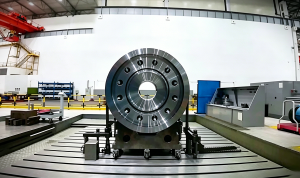
Factories participating in the programme have reported measurable improvements across production and product development.
According to data cited from China’s Ministry of Industry and Information Technology (MIIT), smart factories have achieved an average 47% reduction in product defect rates, while average product development cycles have been shortened by 38%.
The four-tier system evaluates factories according to increasing levels of digitalisation, connectivity and intelligent manufacturing capability.
AI application capability has now been incorporated into the assessment criteria for Excellence-level and Leading-level smart factories, with requirements expected to increase as industrial AI technologies develop.
Industrial AI Moves Into Factory Operations
Manufacturers are increasingly moving beyond conventional automation towards AI systems capable of analysing operational information and supporting production decisions.
At an Excellence-level factory operated by TBEA Shenyang Transformer Group, an integrated digital platform connects simulation, production scheduling, execution and monitoring.
The facility has reported a 21% reduction in product development cycles and a 40% improvement in production efficiency.
The company is also using algorithms to analyse real-time transformer operating data and assess equipment health.
The system can provide warnings around eight to 12 hours before potential equipment issues emerge, allowing maintenance teams to respond earlier.
AI Accelerates Shipbuilding Planning
Industrial AI is also being introduced across China’s shipbuilding sector.
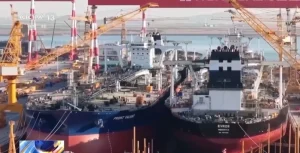
At Hengli Shipbuilding in Dalian, digital systems connect activities including design, planning, procurement, supply chain management, production and finance.
Planning work that previously required two employees more than two weeks can now be completed largely through AI software in around 30 minutes, with personnel focusing on verification and adjustments.
The example demonstrates how AI is being applied not only to physical production processes but also to complex industrial planning and operational coordination.
Automotive Manufacturing Becomes a Smart Factory Showcase
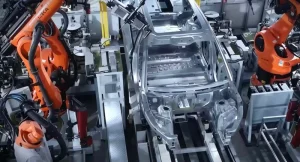
China’s automotive industry is one of the sectors identified for further Leading-level smart factory development and large-scale industrial AI deployment.
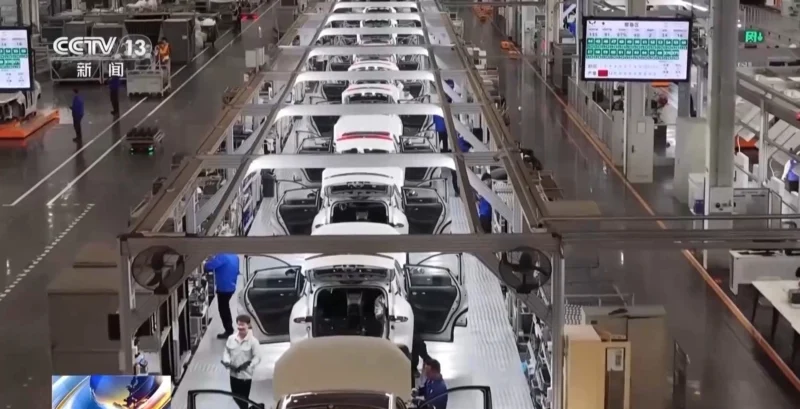
Advanced automotive plants are already combining AI, industrial internet platforms, digital twins and highly automated production systems.
Other priority industries include rail transit equipment, aerospace, high-tech shipbuilding, steel and petrochemicals.
These sectors typically operate complex production environments where greater integration between equipment, data and software can support improvements in productivity, quality and operational visibility.
China Builds Industrial AI Infrastructure
MIIT plans to further support the development of industrial foundation models, sector-specific AI models and high-quality industrial datasets as manufacturers increase their use of AI.
China is also seeking to develop industrial equipment such as robots, machine tools and control systems with more intelligent and autonomous capabilities.
The country’s intelligent manufacturing equipment, industrial software and system solutions industry has already exceeded 4.5 trillion yuan, while the system integration services market has surpassed 770 billion yuan.
China’s smart factory programme is continuing to expand. In its July 2026 programme update, MIIT maintained the four-level development structure and called for further development of smart factories and industrial intelligent agents as part of the country’s next phase of manufacturing digitalisation.
The growing network reflects China’s shift from factory digitalisation towards deeper integration of AI within production, maintenance, planning and industrial equipment.