

IIT Madras Develops SEANAV Digital Twin for Autonomous Maritime Navigation Testing
IIT Madras has created SEANAV, a real-time digital twin platform integrating AI and sensor fusion to enhance autonomous ship navigation safety.

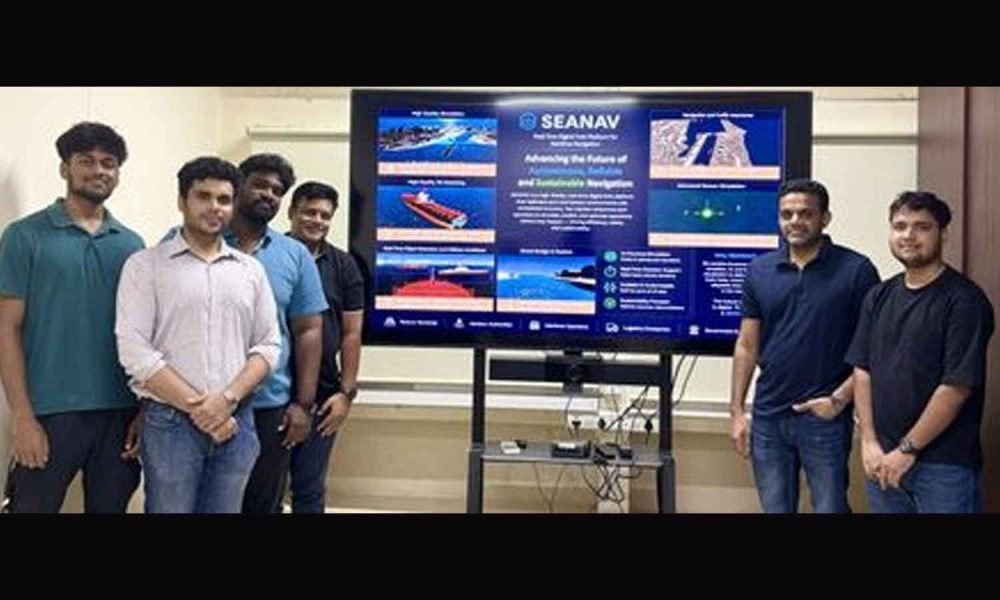
Researchers at the Department of Ocean Engineering, Indian Institute of Technology Madras, have developed SEANAV, a real-time digital twin platform designed to test and train autonomous maritime navigation systems, aimed at improving vessel safety at sea. The platform integrates artificial intelligence (AI), virtual reality (VR), and multi-sensor fusion technologies to replicate maritime environments for pre-departure evaluation.
Quick Skim
SEANAV Simulates Complex Maritime Conditions
Built on a Unity-based simulation engine, SEANAV generates realistic ocean waves, variable shipping traffic, and adverse weather scenarios. It supports AI-driven collision avoidance and path-following manoeuvres for multiple autonomous vessels navigating congested waterways simultaneously. The platform also incorporates an immersive VR interface for training maritime professionals.
Multi-Sensor Fusion Enhances Target Detection
The IIT Madras team developed a new dataset, ‘DetectShips’, containing 14,000 real ship images combined with existing datasets to improve the training of computer vision algorithms integrated with stereo vision sensors. They introduced ‘StereoLiD’, which fuses data from stereo cameras and LiDAR sensors to enhance depth estimation accuracy. This fusion uses a Kalman filter to precisely localise targets, addressing limitations of conventional optical sensors in conditions such as variable lighting and dense fog.
According to the researchers, this approach improves environmental perception in dynamic marine settings, which is critical for autonomous navigation reliability.
Implications for Maritime Operations in Asia-Pacific
SEANAV’s capability to simulate thousands of hours of virtual navigation reduces the need for costly physical trials and supports safer, more sustainable shipping operations. Its use may optimise autonomous vessel deployment and operator training within Asia-Pacific’s busy maritime corridors, where congested waterways and challenging weather conditions prevail.
The research was published in the Journal of Offshore Mechanics and Arctic Engineering and presented at ASME OMAE conferences in Vancouver and Tokyo. Future developments are likely to focus on enhancing sensor integration and expanding environmental scenario modelling to further improve autonomous navigation safety.