






Malaysia’s Q2 Growth Seen Accelerating as Exports and AI-Related Demand Stay Strong
Malaysia’s economy was expected to record stronger growth in the second quarter of 2026, supported by resilient domestic demand, rising exports and continued demand for semiconductors and...

Malaysia’s economy was expected to record stronger growth in the second quarter of 2026, supported by resilient domestic demand, rising exports and continued demand for semiconductors and data-processing equipment linked to artificial intelligence.
Quick Skim
A Reuters poll of 21 economists projected Malaysia’s gross domestic product to grow 5.8% year on year in the April-to-June quarter, accelerating from 5.4% in the first quarter. Forecasts ranged between 5.7% and 6.0%.
The projection was in line with Malaysia’s preliminary second-quarter growth estimate released in July.
Exports Accelerate in June
Malaysia’s export performance strengthened significantly towards the end of the second quarter.
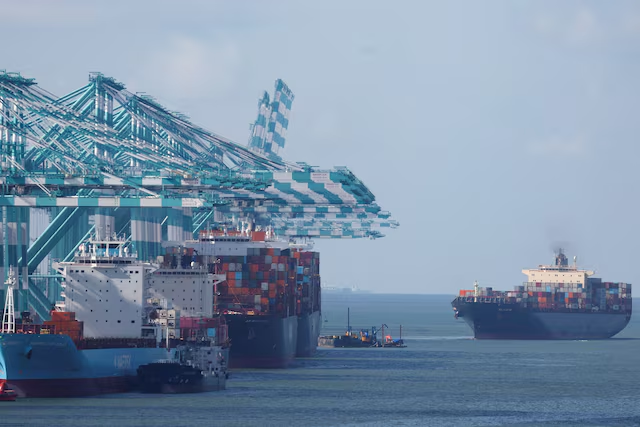
Exports increased 45.4% year on year in June, marking the fastest growth since August 2022. The country also recorded a RM14.9 billion (US$3.65 billion) trade surplus during the month.
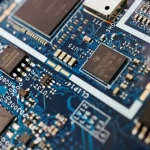
Electronics remain an important contributor to the export outlook, supported by continued global demand for semiconductors and data-processing equipment.
Economists expect AI-related investment to continue supporting Malaysia’s electronics sector as technology companies expand computing and data-centre infrastructure.
AI and Data Centres Support Technology Demand
Malaysia has emerged as one of Southeast Asia’s fastest-growing data-centre markets, attracting investment from international technology companies seeking additional capacity in the region.
This expansion is supporting demand across parts of the industrial technology supply chain, including semiconductors, electronics and data-processing equipment.
Economist Intelligence Unit economist Qi Hang Tay said strong semiconductor demand, AI adoption and rapid data-centre expansion by US and European technology companies were supporting Malaysia’s current economic upcycle.
Electronics exports are also expected to remain a key growth driver, with economists seeing little indication of a near-term slowdown in AI-related demand.
Domestic Demand Remains Resilient
Malaysia’s growth is being supported not only by exports but also by domestic economic activity.
Employment conditions, household consumption and fiscal measures introduced earlier in the year have helped maintain consumer demand. Credit-card spending has also remained resilient.
The combination of external demand and domestic spending has helped Malaysia maintain growth despite uncertainty surrounding global trade and the Middle East conflict.
Malaysia’s central bank expects the economy to expand between 4% and 5% in 2026, broadly in line with a separate Reuters poll forecasting 4.5% growth.
Electronics Remain an Important Growth Driver
Malaysia’s position within the regional electronics and semiconductor supply chain continues to provide support for manufacturing and exports.
Global investment in AI infrastructure is increasing demand for computing hardware and semiconductor components, creating opportunities for manufacturing economies across Asia.
For Malaysia, this demand is being reinforced by new data-centre investment and continued diversification of technology supply chains across Southeast Asia.
As manufacturers and technology companies increase capacity in the region, electronics exports are expected to remain an important contributor to Malaysia’s industrial and economic performance.
Growth Outlook Remains Supported
Bank Negara Malaysia has maintained its benchmark interest rate at 2.75% since July 2025, with economists surveyed by Reuters expecting the rate to remain unchanged through the end of 2027.
Malaysia entered the second half of 2026 with strong export momentum, resilient domestic spending and continued investment in technology infrastructure.
While geopolitical and global economic risks remain, demand for semiconductors, electronics and AI-related infrastructure continues to provide support for the country’s manufacturing and export sectors.