






Physical AI Takes a Practical Path in Southeast Asia
Physical AI is gaining ground across Southeast Asia, but the region’s adoption is expected to look different from the humanoid robot race taking place in markets such as China. Instead, businesses...

Physical AI is gaining ground across Southeast Asia, but the region’s adoption is expected to look different from the humanoid robot race taking place in markets such as China. Instead, businesses are focusing on practical applications that address labour shortages, improve productivity and support existing workers.
Quick Skim
Physical AI refers to AI-enabled systems that can perceive their surroundings, make decisions and perform actions in the physical world. The technology can be applied across industrial robots, autonomous vehicles, drones, mobile robots and other forms of automation — not only humanoid machines.
For Southeast Asia, applications in areas such as manufacturing, logistics, delivery, public services and care could provide a more immediate route towards wider adoption.
Labour Gaps Create Opportunities for Automation
Southeast Asia is often viewed as having less urgency to automate because many countries in the region still have relatively young and growing workforces.
However, labour pressures are already emerging in specific industries and markets.
Charlie Dai, Vice-President and Principal Analyst at Forrester, highlighted labour availability as an increasingly important consideration for physical AI adoption across the region. Rather than replacing workers broadly, robotics could be deployed where companies are struggling to fill particular roles or where tasks are repetitive, physically demanding or difficult to staff.
Singapore presents one of the clearest examples.
The country already has one of the world’s highest concentrations of industrial robots, while its ageing population and constrained labour market are encouraging companies to explore further automation.
Humanoid Robots Are Only Part of Physical AI
Although humanoid robots have attracted significant attention, particularly in China, industry analysts caution against treating the humanoid form as the main measure of progress in physical AI.
Forrester argues that many other forms of physical automation can be cheaper, more durable and better suited to specific operational tasks than humanoid robots.
For manufacturers, this could mean intelligent robotic arms that adapt to different products, autonomous mobile robots moving materials around factories, drones carrying out inspections or AI-enabled machines adjusting their actions based on changing operating conditions.
The focus is therefore shifting from how closely a robot resembles a person towards how effectively an AI-enabled machine can perform useful work.
Industrial Robotics Becomes a Key Starting Point
Manufacturing is expected to remain one of the most important environments for physical AI development.
Industrial robotics is already the most mature testing ground for the technology, providing manufacturers with existing infrastructure and operational experience that can support more advanced AI capabilities.
Physical AI can allow robots to move beyond fixed and highly repetitive programming.
By combining AI with machine vision, sensors and real-time processing, robotic systems can become more capable of recognising changes in their surroundings and adapting their actions.
This creates opportunities in areas such as material handling, assembly, quality inspection, warehousing and other production activities where greater flexibility is required.
However, adoption remains relatively early. Only 5% of companies surveyed by Deloitte said physical AI is transforming their industries today, although 41% expect that to happen within three years.
Singapore Builds a Real-World Physical AI Testbed
Singapore is creating infrastructure to help move physical AI from controlled trials into real operating environments.
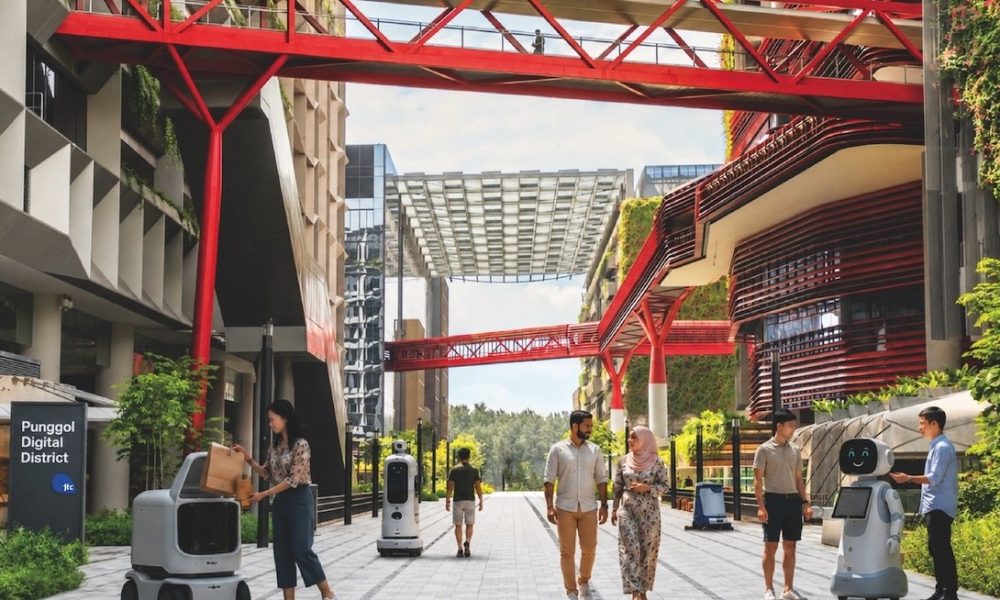
The Infocomm Media Development Authority, JTC and Singapore Institute of Technology are establishing a physical AI testbed at Punggol Digital District, scheduled to launch later in 2026.
The project will allow robots from multiple operators to operate within the same mixed-use environment.
Companies including Certis, DHL, Grab and QuikBot are expected to test applications covering parcel and food delivery, cleaning and security patrols alongside existing human operations.
The initiative is intended to help companies understand how autonomous systems perform in more complex real-world environments rather than limiting testing to individual warehouses, laboratories or factories.
Adoption Depends on More Than Robot Technology
Scaling physical AI also requires organisations to address operational challenges around cost, skills, data and integration.
Deloitte identified cost and resource requirements as the leading adoption barrier, cited by 41% of organisations, followed by difficulty identifying suitable use cases at 36%, skills shortages at 33% and technology or data availability at 31%.
Companies therefore need to determine where physical AI can deliver practical operational value before investing in more complex systems.
This is particularly relevant in Southeast Asia, where labour costs, infrastructure readiness and industrial maturity can vary significantly between markets.
Rather than following a single model of automation, businesses are likely to adopt different types of robots based on specific operational requirements.
Southeast Asia Takes a Use-Case-Driven Approach
Physical AI adoption across Southeast Asia is therefore expected to develop around practical applications rather than the race to deploy humanoid robots.
Manufacturing and logistics provide immediate opportunities, while labour shortages in delivery, public services and care could create additional demand for autonomous systems.
As AI capabilities improve and robotics costs decline, more machines will be able to perceive, reason and react to changing physical environments.
For Southeast Asia, the development of physical AI may ultimately be defined less by the appearance of the robot and more by whether it can solve real operational problems reliably and economically.