






Synopsys Joins Singapore Consortium to Improve Cooling in Tropical Data Centres
Synopsys has joined a National University of Singapore-led programme to develop cooling solutions and digital modelling for data centres in tropical climates.

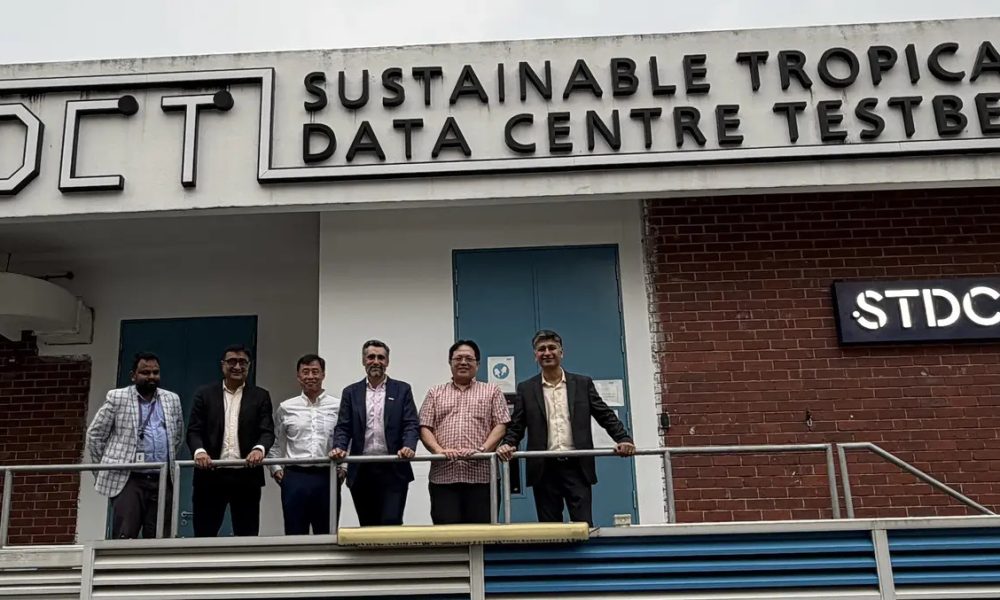
Synopsys has joined the Sustainable Tropical Data Centre Testbed 2.0 consortium, led by the National University of Singapore (NUS), to advance cooling technologies and digital modelling for data centres operating in tropical conditions. The initiative focuses on addressing challenges associated with elevated temperatures and humidity, which increase cooling demands and energy consumption in regional facilities.
Quick Skim
Consortium Targets Cooling Efficiency in Hot, Humid Climates
Data centres in tropical regions typically face ambient temperatures exceeding 24-32°C and humidity levels reaching 70-80%. These conditions reduce the efficiency of conventional cooling systems, often resulting in cooling energy usage accounting for up to 40% of a data centre’s total consumption, a higher proportion compared to cooler climates.
The consortium’s research prioritises two-phase direct-to-chip cooling for AI accelerators and the development of digital twins for predictive thermal management. Workstreams include computational fluid dynamics, multiphysics simulation, and AI-assisted thermofluid design, linking detailed simulations with physical testing in the consortium’s live testbed environment.
Synopsys Provides Simulation Tools and Expertise
Synopsys contributes software access, technical skills, training, and mentorship to support the project. The company intends to integrate its multiphysics simulation and AI-assisted engineering capabilities with the testbed’s experimental data. This approach aims to generate reduced-order models for digital twin implementations and operational decision-making.
Padmesh Mandloi, Vice President, Synopsys Simulation and Analysis APAC, said the collaboration enables connection of multiscale and multiphysics behaviours from chip to data centre level, facilitating scalable cooling and digital twin solutions.
Implications for Tropical Data Centre Operations
The project addresses a key operational challenge in Southeast Asia, where rapid expansion of data centres must balance increased computing demands with rising energy and water consumption pressures. By validating cooling strategies digitally and physically, the consortium hopes to optimise design options and reduce energy use in dense AI workloads.
Professor Lee Poh Seng of NUS emphasised that the programme provides a co-innovation platform to transition technologies from simulation to real-world deployment, supporting the development of AI-ready infrastructure tailored for the tropical environment.
Looking ahead, the consortium’s planned workflow and testbed validation are expected to inform scalable cooling designs and digital twins applicable across tropical markets in Asia-Pacific.