



AI Demand Drives Factory Expansion Across Asia in August
Manufacturing activity strengthened across much of Asia in August as global demand for AI hardware, semiconductors and electronics supported factory orders and exports, with China, Japan and South...

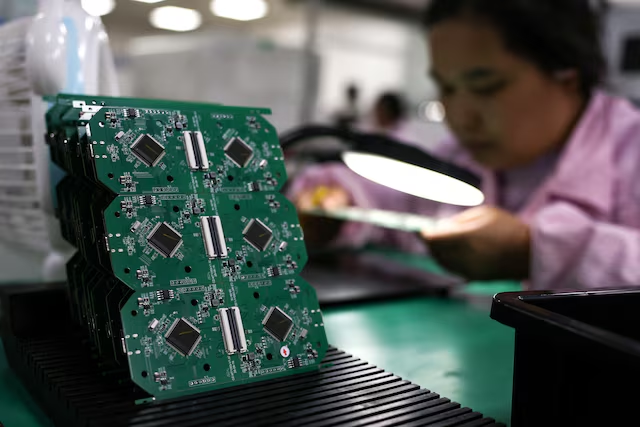
Manufacturing activity strengthened across much of Asia in August as global demand for AI hardware, semiconductors and electronics supported factory orders and exports, with China, Japan and South Korea among the economies reporting expansion.
Quick Skim
- China Manufacturing Growth Accelerates
- Japan Factory Orders Reach Eight-Year High
- South Korea Extends Manufacturing Expansion
- Taiwan Benefits From Semiconductor Cycle
- Southeast Asia Records Mixed Factory Performance
- India Manufacturing Growth Slows
- AI Becomes a Major Driver of Regional Manufacturing
Private manufacturing surveys showed the AI and semiconductor investment cycle continuing to provide momentum for export-oriented producers across the region, although conditions remained uneven as manufacturers faced higher costs and geopolitical uncertainty.
Factory activity also expanded in Taiwan, Malaysia and the Philippines, while Indonesia slipped back into contraction and India recorded its slowest manufacturing growth in five years.
China Manufacturing Growth Accelerates
China’s RatingDog General Manufacturing Purchasing Managers’ Index rose to 51.5 in August from 50.9 in July, remaining above the 50-point level that separates expansion from contraction.
The reading also exceeded expectations, supported by stronger overseas demand and continued orders for technology-related products.
AI-linked manufacturing has become an important source of growth for parts of China’s industrial sector, even as broader domestic manufacturing indicators remain mixed.
Japan Factory Orders Reach Eight-Year High
Japan’s manufacturing sector continued to strengthen during August.
The S&P Global Japan Manufacturing PMI increased to 54.9 from 54.5 in July, marking an eighth consecutive month of expansion.
New business grew at its fastest pace since January 2018, supported by demand for semiconductors and other AI-related technologies.
Export orders also strengthened as Japanese manufacturers recorded increased demand from markets including North America, Southeast Asia and China.
South Korea Extends Manufacturing Expansion
South Korea remained in expansion territory for a ninth consecutive month.
Its manufacturing PMI eased to 52.3 in August from 53.1 in July, but continued to indicate solid factory growth.
Strong semiconductor and technology exports remained an important driver of manufacturing activity as global investment in AI infrastructure increased demand for advanced chips and related equipment.
South Korean exports also continued their strong growth momentum during the month.
Taiwan Benefits From Semiconductor Cycle
Taiwan’s manufacturing PMI remained strong at 54.7 in August, supported by its central role in the global semiconductor and electronics supply chain.
AI data centres and advanced computing systems are increasing demand for processors, memory, networking equipment and supporting electronic components.
This has translated into higher production requirements across Taiwan’s extensive semiconductor manufacturing ecosystem.
Southeast Asia Records Mixed Factory Performance
Manufacturing conditions across Southeast Asia were more varied.
The Philippines recorded one of the region’s strongest improvements, with its manufacturing PMI rising to 54.9 from 51.8 in July.
Malaysia remained marginally in expansion territory with a PMI of 50.2, although growth slowed from the previous month.
Indonesia moved in the opposite direction, with its PMI falling to 49.8 from 50.2, pushing manufacturing activity back into contraction.
The difference highlights how economies more closely connected to electronics and technology supply chains are benefiting more directly from the current AI investment cycle.
India Manufacturing Growth Slows
India’s manufacturing sector remained in expansion but recorded its weakest growth in five years.
Slower demand weighed on factory activity and contributed to the first decline in manufacturing employment in more than two years.
The slowdown contrasts with stronger conditions in several East Asian markets where semiconductor and AI-related exports are providing greater support to production.
AI Becomes a Major Driver of Regional Manufacturing
The August factory data shows how quickly AI infrastructure investment is feeding into Asia’s wider manufacturing economy.
Demand extends beyond advanced processors to include memory chips, networking equipment, electronics components, semiconductor materials and production equipment.
Japan, South Korea, Taiwan and China are among the largest beneficiaries because of their established positions across these supply chains.
Parts of Southeast Asia are also gaining as electronics manufacturers expand production and diversify regional manufacturing networks.
However, the recovery remains uneven, with manufacturers still facing risks from geopolitical tensions, energy prices, input costs and changing global trade conditions.
For now, continued investment in AI data centres and semiconductor capacity is providing one of the strongest sources of momentum for Asia’s manufacturing sector.