Selangor Launches Rail Industry Hub to Build Local Train Assembly and Testing Capabilities
Selangor has launched a new Rail Industry Hub in Hulu Selangor to strengthen Malaysia’s capabilities in train assembly, testing, system integration, simulator development and rail supply-chain...

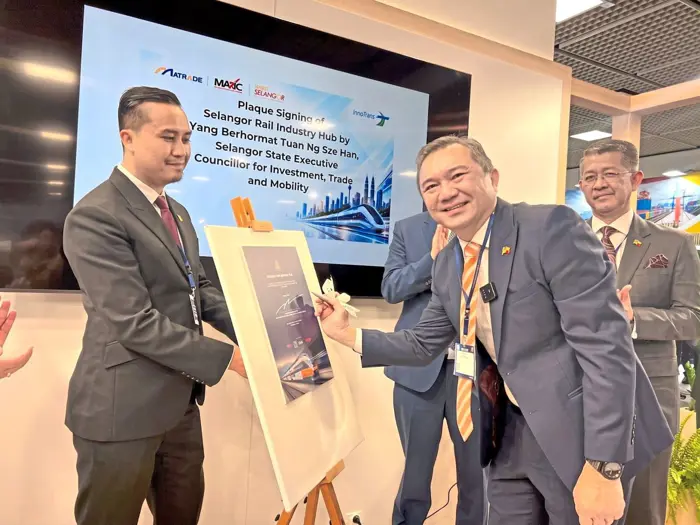
Selangor has launched a new Rail Industry Hub in Hulu Selangor to strengthen Malaysia’s capabilities in train assembly, testing, system integration, simulator development and rail supply-chain localisation.
Quick Skim
- First Phase Uses Existing SIRIM Facilities
- Hub Focuses on Four Core Areas
- MMC Engineering Plans Local Assembly and Testing
- Pecca to Establish Rail Training Academy
- Xcel Itech Targets Train Simulator Development
- Selangor Builds Rail Supply-Chain Ecosystem
- Workforce Becomes a Key Priority
- Rail Hub Supports Localisation and Maintenance
The hub will be developed in phases at Taman Perindustrian Zurah in Rasa, beginning with existing facilities at SIRIM before potentially expanding into a dedicated rail industrial park covering more than 50 hectares.
First Phase Uses Existing SIRIM Facilities
The first phase will occupy around 36,000 sq ft of built-up space at SIRIM Bhd’s premises.
Using existing facilities allows the project to begin with lower upfront investment while giving participating companies access to technical validation and compliance support under Malaysia Railway Industry Standards.
A second phase is planned on adjacent land, while a longer-term third phase could expand into a much larger dedicated rail industrial park.
Hub Focuses on Four Core Areas
The Selangor Rail Industry Hub will concentrate on four main activities:
- Local train assembly and testing
- Proof-of-concept and system integration
- Train simulator development
- Supply-chain localisation
The aim is to strengthen Malaysia’s domestic rail engineering base while reducing dependence on imported systems and services.
MMC Engineering Plans Local Assembly and Testing
Three companies have already indicated plans to establish operations within the hub.
MMC Engineering Bhd intends to develop local train assembly and testing capabilities, supporting Malaysia’s growing rail infrastructure and fleet requirements.
The hub could also provide a location for future overhaul and lifecycle-management activities as ageing rail assets require maintenance, refurbishment and system upgrades.
Pecca to Establish Rail Training Academy
Pecca Leather Bhd plans to establish a specialised training academy focused on rail seating and upholstery standards.
The initiative is intended to support workforce development as Malaysia’s rail sector expands.
Talent development will also be supported through the Rail Teaching Factory framework and the Selangor Talent Action Plan for Rail Industry.
Xcel Itech Targets Train Simulator Development
Xcel Itech Sdn Bhd will work with SIRIM on the localisation, testing, validation and commercialisation of train simulator platforms.
Simulation technologies can support driver training, system testing and operational preparation without requiring physical rolling stock to be continuously used for training purposes.
This adds a digital engineering component to the wider rail manufacturing and services ecosystem.
Selangor Builds Rail Supply-Chain Ecosystem
The initiative forms part of Selangor’s broader strategy to expand beyond its established strengths in electrical and electronics, semiconductors and advanced manufacturing.
The state sees rail as another industrial sector where local engineering, testing and supplier capabilities can be developed around existing infrastructure.
Selangor’s connectivity to Port Klang and major rail corridors also provides a logistics advantage for companies involved in rolling stock, components and engineering services.
Workforce Becomes a Key Priority
Malaysia’s growing rail network is expected to increase demand for skilled workers across engineering, maintenance, operations and technology.
The new hub is therefore being developed not only as a manufacturing location but also as a workforce and technical-development centre.
Building local engineering capabilities could support areas such as asset lifecycle management, maintenance, system integration and digital rail technologies as the domestic rail network expands.
Rail Hub Supports Localisation and Maintenance
For Malaysia’s rail industry, the Selangor project represents a move towards building a more complete domestic ecosystem rather than relying primarily on imported rolling stock and engineering expertise.
By combining assembly, testing, training, simulation and supply-chain localisation in one location, the hub could support both new rail projects and the maintenance requirements of existing fleets.