





LG Pushes Factory-Floor AI With EXAONE Models Built for Industrial Data
LG Group is expanding its home-grown EXAONE artificial intelligence across manufacturing operations, using proprietary factory data to improve production planning, quality inspection and process...

LG Group is expanding its home-grown EXAONE artificial intelligence across manufacturing operations, using proprietary factory data to improve production planning, quality inspection and process optimisation while reducing the computing resources needed to run industrial AI.
Quick Skim
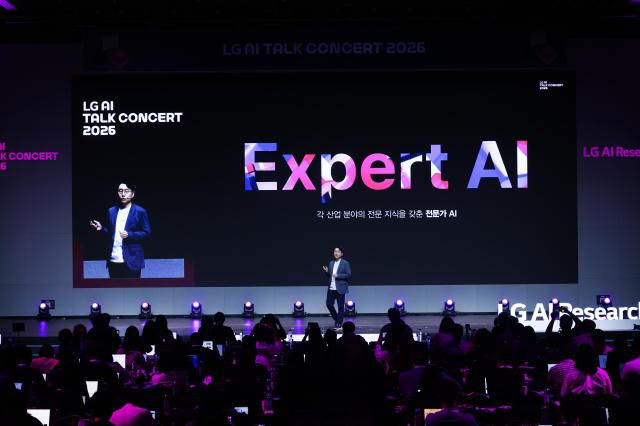
LG AI Research outlined the strategy at the LG AI Talk Concert 2026 in Seoul, positioning what it calls “Expert AI” as a practical alternative to general-purpose models for manufacturers that require faster responses, greater data security and technology tailored to specific production environments.
Factory Data Becomes LG’s AI Advantage
LG argues that industrial AI requires a different approach from consumer-facing generative AI.
Factories generate large volumes of proprietary information covering production conditions, equipment behaviour, materials and product quality, much of which is not available in public datasets used to train general-purpose models.
LG AI Research is combining its foundation models with this operational knowledge across businesses spanning electronics, components and chemicals.
Since its establishment in 2020, the research arm said it has worked on more than 100 industrial problems, including battery-life prediction, quality inspection and production and materials planning.
EXAONE Tabular Targets Manufacturing Data
One of LG’s main industrial AI tools is EXAONE Tabular, a foundation model designed to analyse structured data commonly used in factories.
The model can examine relationships between variables such as production settings and quality measurements and make predictions even when relatively limited data is available for a new task.
LG said it prioritised lower computing requirements and faster response times rather than simply increasing model size.
The company said EXAONE Tabular can operate on comparatively modest GPU infrastructure and deliver results within seconds when installed on a customer’s own servers.
This could become increasingly important for manufacturers looking to scale AI without significantly increasing computing infrastructure costs.
LG Innotek Cuts AI Retraining Time by 85%
EXAONE Tabular has already been deployed at LG Innotek.
According to LG AI Research, adapting an AI model to changing manufacturing conditions previously required more than 300 hours, or roughly 14 days, of retraining.
The process has now been reduced to around 50 hours, representing an 85% decrease.
Reducing retraining time could make AI systems easier to maintain as products, production parameters and factory conditions change.
AI Inspection Adapts to Production Changes
LG is also developing EXAONE Omni-Inspect, a visual-inspection foundation model designed to handle changes in products and manufacturing environments without requiring an entirely new model to be trained for every variation.
The company plans to apply the system to an actual inspection process during 2026.
Its longer-term goal is to develop AI agents that can respond more autonomously when factory conditions change.
For manufacturers, this could reduce the engineering workload involved in maintaining machine-vision systems across different products and production lines.
On-Premise AI Keeps Factory Data Inside
Data security is another part of LG’s industrial AI strategy.
Manufacturers can deploy EXAONE models on-premise, allowing sensitive production information to remain within their own IT infrastructure rather than being transmitted to external cloud services.
LG said Korean companies have shown greater interest in on-premise deployments, while international customers have generally shown stronger preference for cloud-based API access.
The flexibility allows industrial customers to choose between easier cloud deployment and tighter control over proprietary factory data.
Physical AI Could Connect Entire Factories
LG’s longer-term ambition extends beyond analytics and inspection.
The company is developing robot foundation models capable of understanding physical environments, making decisions and taking actions.
LG envisions future factories where human operators establish production and quality targets while AI coordinates robots, inspection systems and optimisation software across the plant.
Rather than automating individual machines separately, the goal is to create an integrated factory system where AI can continuously analyse data, make decisions and adapt operations.
Industrial AI Moves From Models to Operations
LG’s strategy reflects a wider shift in manufacturing AI from general-purpose models towards tools designed around specific industrial processes.
For manufacturers, performance is increasingly measured not only by model intelligence but also by speed, computing cost, data security and the ability to adapt to changing production conditions.
LG is betting that its decades of factory data and industrial experience can give EXAONE an advantage in this environment, turning proprietary manufacturing knowledge into AI systems built specifically for real-world production.